

Building a brand identity is often overlooked by Web3 builders. The reason for this is generally short-term thinking. Increasingly, in the current market, teams want results quickly, and they are less interested in deploying resources for long-term Web3 brand design.
If someone is launching a token on pump.fun, then admittedly, there is probably no need for identity building, but for teams that want to become leaders in the crypto industry, it is critical.
To become a top 100 coin by market capitalization or to develop a successful NFT project like Pudgy Penguins, a simple logo and some crypto press release distribution simply are not enough.
For teams that are serious about becoming leaders in any crypto sector, whether it is DeFi, AI, or even a serious memecoin project, a crypto brand strategy with a clear vision for graphic design, tone of voice, and crypto brand positioning has to be a central theme of development from day one.
This article will explain how to build a crypto brand identity in 2026, offering insights into real projects and specific crypto marketing tools that the most successful brands in crypto leverage.
Why Branding is the Most Valuable Currency in Crypto
Although crypto remains a fairly anonymous industry, with many projects launched by teams that may never show their faces, trust is an increasingly valuable commodity. Every time a project rugs, an exchange gets exploited, or faulty code in a DeFi protocol leads to massive losses, the community becomes more skeptical.
Trust, therefore, does not correlate directly with a team being doxxed. Bitcoin, the most trusted crypto project by some margin in the industry, famously has an anonymous founder, but its brand is so powerful and trusted that even some of the biggest corporations in the world are now adding BTC to their balance sheets.
Increasingly, users are avoiding projects that do not have a strong identity. While shorter-term memecoins still generate plenty of volume, they almost never turn into successful long-term projects. Almost every memecoin launched on pump.fun dies within the first few hours of launch, and the same applies to many coins launched on platforms such as four.meme.
So while crypto brand identity building might not seem like the most exciting aspect of building a crypto project, it has the potential to create a committed community of investors around a project that a handful of flashy programmatic ads or PR articles simply cannot offer.
The Foundation: Brand Positioning & Values
There are a few core elements of a crypto brand identity that need to be clearly understood before starting a brand-building campaign. The direction has to be clear. If the team is not aligned on the direction they plan to take, then it will be almost impossible to succeed in creating an identity for a project that the community will trust. Before creating visuals and planning content calendars, it is important to have documented clarity.
The team also needs to be clear on the positioning of the project. If it is a new DeFi project, who is the target market and where does it want to fit within the sector? If it is a crypto casino, what type of players is it trying to attract? If it is a memecoin, what is its place within an extremely crowded market? Without clear positioning, branding quickly becomes inconsistent.
The tone of voice must also be decided early. A serious DeFi protocol may require more technical and professional communication, while a meme project will likely be more lighthearted and community-driven. If the project is a Layer-1 blockchain targeting developers, then more technical language may be acceptable. The important thing is maintaining a clear tone consistently across all communications.
Once the tone and positioning are clear, the team can begin planning the visuals. These visuals must align with the tone of the project. A Layer-1 smart contract protocol should have very different branding guidelines compared to a memecoin project targeting retail traders and social media communities.
Crafting the Visual Identity System
The visual identity is a central part of any blockchain brand-building campaign. This process is best left to expert designers with experience in the Web3 market. There are four major areas of visual branding to focus on.
The Logo
A crypto logo needs to be simple, memorable, and scalable across multiple formats, including exchange listings, wallets, websites, and conference banners. Overly complex logos often fail when resized for smaller interfaces.
Sui is a strong example of clean and recognizable logo design. Its minimal water-drop symbol works effectively across both technical and retail-facing branding.
Chainspin uses darker typography and stronger visual contrast to reinforce its positioning as a premium crypto wagering platform, helping the logo align with the gambling and casino sector.
Color Palette
Blue and purple dominate Web3 branding because they are strongly associated with trust, security, finance, and technology. However, projects still need ways to visually differentiate themselves.
Pudgy Penguins uses bright, playful colors to create a more approachable and community-driven identity, which fits its NFT audience and merchandise strategy.
Serious DeFi or infrastructure projects often use darker palettes and cleaner gradients to communicate professionalism and technical credibility.
Typography
Typography needs to balance readability with personality. Crypto platforms often display complex financial data, so fonts must remain clear across both desktop and mobile interfaces.
A Layer-1 blockchain targeting developers may use sharper and more technical typography styles, while consumer-facing projects may use softer and more accessible fonts.
Consistent typography across websites, whitepapers, social media graphics, and pitch decks helps reinforce professionalism and recognition.
Imagery & Illustration
Generic floating coins and stock blockchain graphics are increasingly outdated in crypto branding. Strong projects build unique visual systems that users can instantly recognize.
Pudgy Penguins is one of the strongest examples of custom illustration branding in Web3, extending its visual identity across NFTs, merchandise, toys, and social media content.
High-quality custom illustrations, 3D graphics, or generative art systems can help projects stand out in crowded sectors like DeFi, AI, and memecoins.
Applying the Brand Across Web3 Touchpoints
Building a strong crypto brand identity is not just about creating a logo or choosing colors. The branding has to remain consistent across every touchpoint where users interact with the project. Inconsistent branding creates confusion and weakens trust, especially in crypto, where users are already highly skeptical.
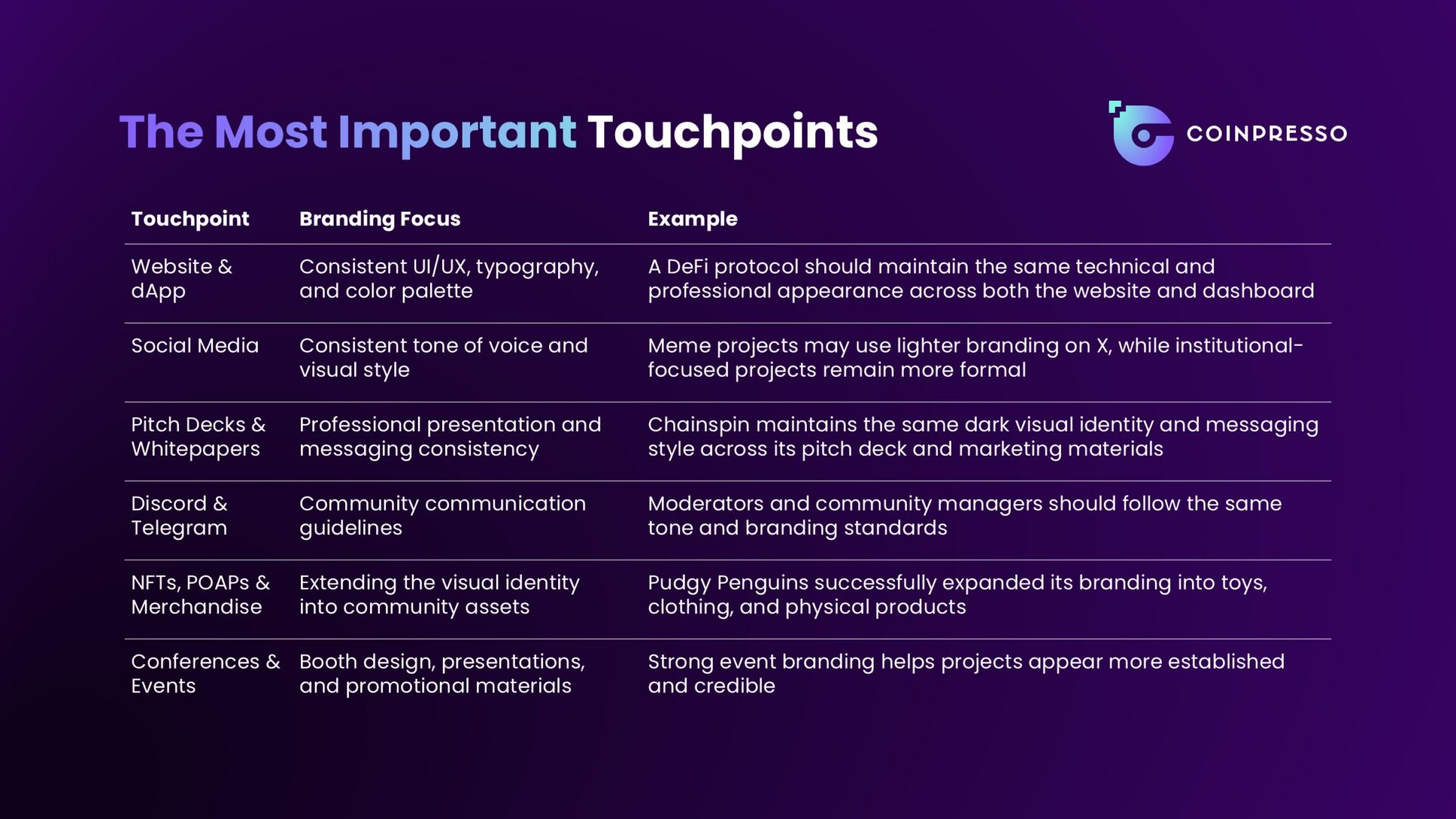
Consistency gradually strengthens recognition, trust, and long-term community loyalty. Spend time looking at any major project, such as Aave or TRON, and their brand power becomes obvious.
Everything is consistent, from X posts and website design to press releases and community messaging. Users can instantly recognize the project across every platform, and in the crypto market, that level of consistency is one of the strongest trust indicators possible.
Final Thoughts on Crypto Brand Identity in 2026
The biggest names in crypto are instantly recognizable. The trust that teams behind projects like TRON, Solana, and BNB Chain have built over time is a product of their brand identity efforts. Although many teams looking to get rich quickly are not interested in methodical Web3 identity building, it is undoubtedly one of the most powerful marketing tools available to developers.
In 2026, with trust becoming an increasingly rare commodity in crypto, branding should not be overlooked. Teams must develop a clear tone of voice, strong market positioning, and consistent visuals if they aim to become leaders within their respective crypto niche.
Frequently Asked Questions
What is the difference between a logo and a brand identity?
A logo is only one part of a brand identity. A full crypto brand identity includes the logo, color palette, typography, tone of voice, illustrations, website styling, and communication strategy. Projects like Pudgy Penguins are recognizable not just because of their logo, but because every aspect of their branding feels consistent.
Why do so many crypto projects use the color blue?
Blue is strongly associated with trust, finance, security, and technology, which is why it dominates both Web2 fintech and Web3 branding. Projects like Sui and Aave use blue tones to appear more credible and secure to users. However, there are countless projects that don’t use blue, including Bitcoin, so it really isn’t a deal breaker.
How often should a crypto project rebrand?
Rebranding should generally be avoided unless there is a major reason:
The project changes direction significantly
The original branding looks unprofessional
The project expands into a different target market
There are reputation issues tied to the old branding
Frequent rebrands can confuse users and damage trust.
Does brand identity impact token price?
Indirectly, yes. Strong branding can improve trust, recognition, retention, and community loyalty, all of which can contribute to stronger long-term adoption. While branding alone will not make a token succeed, weak branding can make it much harder for a project to compete in crowded sectors like DeFi or memecoins.
How do I ensure my community managers use the right tone of voice?
Projects should create a documented brand voice guide explaining tone, acceptable language, messaging style, formatting rules, and examples of good communication. This helps maintain consistency across X posts, Discord announcements, Telegram discussions, and support interactions.


