

Schema markup is the single most important thing on your crypto website that nobody on your team wants to touch. A bold claim for a few lines of JSON-LD, but consider what it actually is: the only part of your site written directly to the machine that now decides whether your project gets named in an answer or quietly left out of it. Most Web3 teams paste an Organization block into the header on launch day, tick the box and never look at it again, and then wonder why ChatGPT describes their yield farm as a payments app.
Here is the problem in one line: schema.org has next to no crypto vocabulary. A wallet is not an exchange, a DeFi protocol is not a licensed financial service, and the type you choose is the type an AI engine will believe. Over the course of this guide we set out the JSON-LD Coinpresso actually deploys for exchanges, wallets and DeFi protocols, entity by entity, along with the schema mistakes we see on almost every Web3 site we audit, the ones that cancel out the good work without anybody noticing.
Speaking the Machine’s Language
Every page on your site is read twice. A human reads the words, and a machine reads the markup underneath them, and it is the second reading that increasingly decides whether your project exists in an AI-generated answer at all. Structured data is how you tell that machine what kind of thing it is looking at, in a vocabulary it was built to parse, rather than leaving it to infer from prose that was written to persuade a person.
That makes schema the foundational layer of generative engine optimization for crypto and Web3, and also the least glamorous. Nothing on the page changes when you get it right — what changes is the confidence with which an engine can say “this is a non-custodial wallet for Ethereum, built by this team, audited by that firm” instead of hedging, or worse, guessing.
Google has been explicit that structured data is not required for its AI Overviews and is not a ranking factor. Take that at face value. Schema does not buy you a citation — it removes the ambiguity that stops a crawler from working out what your project is, which is the precondition for one.
Core Entity: Organization and WebSite Schema
Before you mark up a single product, the machine needs to know who you are, and this is where most crypto sites fall over at the first fence. An Organization block with a name and a logo is not an identity — it is a business card with nothing on the back, and no amount of crypto SEO on top of it will make a machine recognize who it belongs to.
The properties that do the work are the ones that connect your entity to the rest of the web: a sameAs array pointing at your X account, your GitHub organization, your Crunchbase or CoinGecko listing and any regulator page that names you, a foundingDate, a founder where the team is public, and a url that matches the canonical domain exactly.
The WebSite block sits alongside it and does one job, declaring the site’s name and its search action. Together they give an engine a stable node to hang everything else on. Get this wrong and every product entity below it floats free, attached to nothing a model recognizes.
Schema for Crypto Exchanges
An exchange is the one crypto entity that maps cleanly onto an existing type. Schema.org’s FinancialService is the type for a business that provides financial services, and a centralized exchange, whatever it says about itself in the marketing, is precisely that.
Use FinancialService for the exchange entity itself, then mark up each listed asset or trading pair as a FinancialProduct beneath it, with provider pointing back to the parent. Fee schedules belong in offers with a real priceSpecification, not in a paragraph the crawler has to parse. If you publish live rates, schema.org’s financial vocabulary includes an ExchangeRateSpecification type built for exactly that, though you should read it before you use it, because it was written for banks and the worked examples assume fiat pairs.
You will see agencies recommend a CryptoExchange type as the primary entity. It is not schema.org vocabulary. It is a custom extension, and an engine that does not recognize it will treat it as noise.
Schema for Crypto Wallets
A wallet is software, and the honest schema for software is SoftwareApplication. The mistake almost every wallet makes is reaching for a financial type because the word “wallet” sounds financial. A self-custody wallet holds no funds and provides no financial service; it is an interface to a chain, and it should say so.
What matters inside the block is specificity. operatingSystem and applicationCategory are the properties an engine uses to disambiguate, and “Web3 wallet” in a description is not a substitute for “iOS, Android, Chrome extension” in the fields built for it. Security is the property wallets most need and most often omit. There is no dedicated schema property for “audited by”, so the working pattern is a review or citation pointing at the published audit, plus the audit firm named in author or publisher on that nested entity.
It is a workaround, and it is the best one available until the vocabulary catches up. A wallet holding user keys is the highest-trust product category in the space, and the markup should read like it knows that. The wider trust picture, the signals Google and the engines weigh beyond the markup, is covered in our piece on E-E-A-T for crypto websites.
Schema for DeFi Protocols
DeFi is where the vocabulary genuinely runs out, and where the type you choose is a judgment call rather than a lookup. A lending protocol or a yield vault offers something that looks like a financial product, but it is not a licensed financial service, and marking it as one invites an engine to hold you to a standard you cannot meet.
The pattern Coinpresso deploys is a split. Mark the interface, the dApp your users actually touch, as a SoftwareApplication. Mark the yield mechanics, the specific pool or vault with its stated return, as a FinancialProduct, which schema.org defines as a product provided to consumers and businesses by financial institutions. Link the two with provider and isPartOf, so the machine understands that one organization ships both.
This is our own synthesis against the base vocabulary, and we say so; schema.org’s financial documentation contains no DeFi worked examples at all. A protocol that marks itself as a bank will be judged as a bank. A protocol that marks itself as software with financial products attached is being described accurately, and accuracy is the whole point.
FAQ Schema: The Double-Edged Sword
FAQ schema used to be the easiest win in structured data, and it is now the easiest way to look like you have not been paying attention. Google restricted FAQ rich results to government and health sites in August 2023, and then removed the feature from Search entirely in May 2026, with Search Console and API support following over the summer. The rich snippet is gone, and it is not coming back.
The markup is not useless. A well-structured FAQ block still hands an engine a clean question-and-answer pair it can lift, and for AI retrieval that is worth having on the two or three pages where your buyers genuinely arrive with questions. The double edge is volume. FAQPage on every page of the site, with five generic questions each, is the kind of pattern that reads as manufactured, and a model that has learned to discount manufactured content will discount yours. Use it where the questions are real and the answers are specific. Delete it everywhere else.
Marking Up Tokenomics and Real-Time Data
Dynamic data is where schema meets an uncomfortable truth: a crawler reads what was on the page when it visited, and an APY that was 8.4% on Tuesday is a lie by Friday. The naive fix is to leave the number out. The correct fix is to mark it up honestly.
FinancialProduct supports annualPercentageRate and interestRate, and both should carry a validFrom and, where you know it, a validThrough, so the machine reads a dated figure rather than an eternal promise. Token supply, distribution and vesting are better handled as a Dataset entity with a dateModified and a distribution property pointing at the canonical source, whether that is a page, a CSV or a contract address. The principle is the same one that runs through this whole guide: give the engine a fact it can date and check, not a claim it has to trust.
Common Schema Mistakes in Web3
Most of the schema we audit is not missing. It is contradicting itself. The Organization block says one name, the FinancialService block says another, the footer says a third, and the crawler, faced with three entities where there should be one, resolves none of them with confidence. Conflicting entity definitions are the single most common fault we find, and the easiest to fix, because the fix is a spreadsheet and an afternoon.
The next three, in the order we meet them: marking every page as the Organization rather than reserving that for the homepage and about page; using non-standard types like Cryptocurrency or CryptoExchange that a validator will accept and an engine will ignore; and publishing a sameAs array that points at a dead Medium account and a Telegram group from 2022. One more is worth naming because it is quietly expensive.
A three-page test by Search Engine Land found that well-implemented schema correlated with an AI Overview appearance where poorly implemented schema did not, on a single test, which is suggestive rather than proof. Poorly implemented means exactly the faults above. Schema that validates but contradicts itself may be worse than none.
Implementation Plan
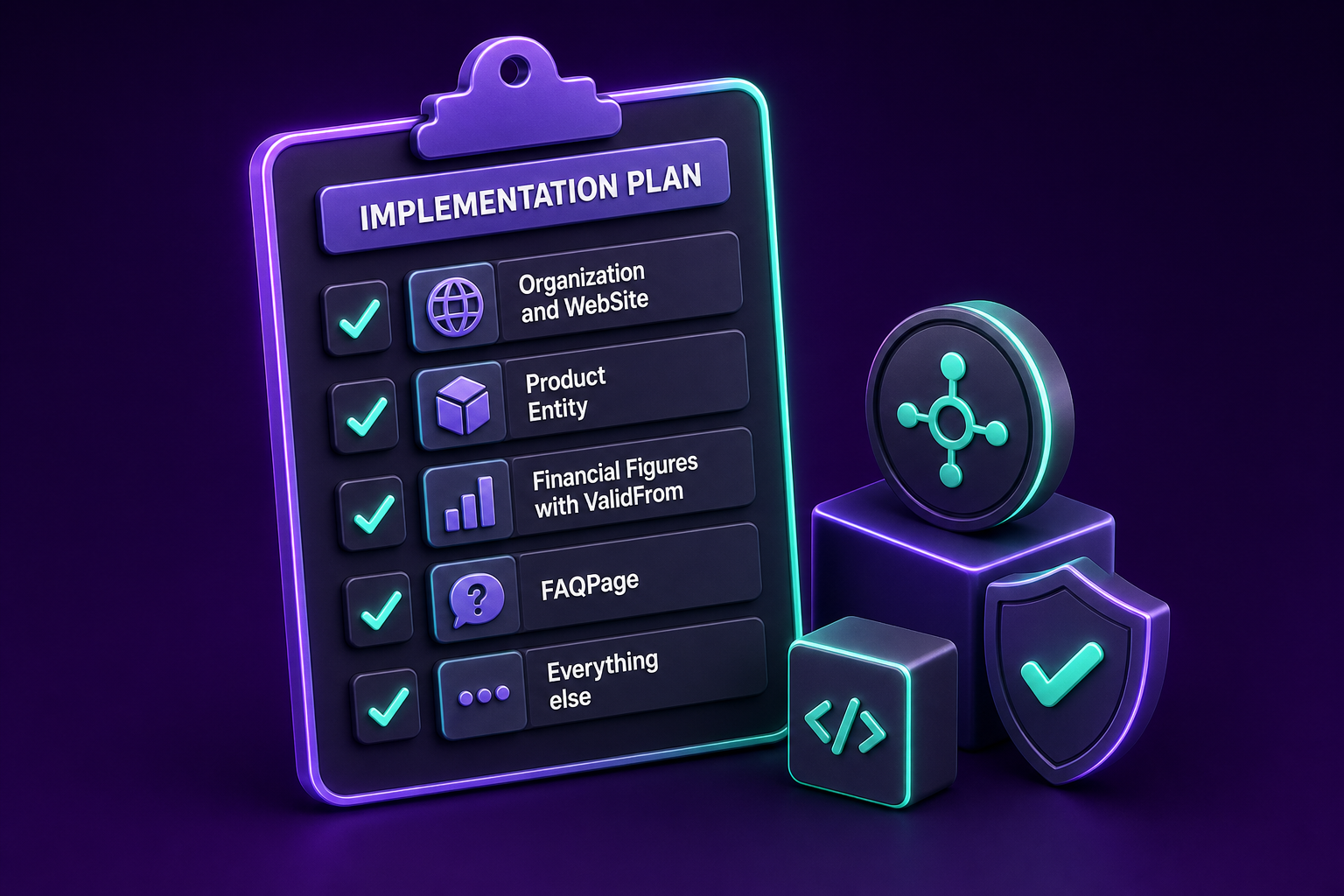
Schema markup is the single most important thing on your crypto website that nobody on your team wants to touch. A bold claim for a few lines of JSON-LD, but consider what it actually is: the only part of your site written directly to the machine that now decides whether your project gets named in an answer or quietly left out of it. Most Web3 teams paste an Organization block into the header on launch day, tick the box and never look at it again, and then wonder why ChatGPT describes their yield farm as a payments app.
Here is the problem in one line: schema.org has next to no crypto vocabulary. A wallet is not an exchange, a DeFi protocol is not a licensed financial service, and the type you choose is the type an AI engine will believe. Over the course of this guide we set out the JSON-LD Coinpresso actually deploys for exchanges, wallets and DeFi protocols, entity by entity, along with the schema mistakes we see on almost every Web3 site we audit, the ones that cancel out the good work without anybody noticing.
Speaking the Machine’s Language
Every page on your site is read twice. A human reads the words, and a machine reads the markup underneath them, and it is the second reading that increasingly decides whether your project exists in an AI-generated answer at all. Structured data is how you tell that machine what kind of thing it is looking at, in a vocabulary it was built to parse, rather than leaving it to infer from prose that was written to persuade a person.
That makes schema the foundational layer of generative engine optimization for crypto and Web3, and also the least glamorous. Nothing on the page changes when you get it right — what changes is the confidence with which an engine can say “this is a non-custodial wallet for Ethereum, built by this team, audited by that firm” instead of hedging, or worse, guessing.
Google has been explicit that structured data is not required for its AI Overviews and is not a ranking factor. Take that at face value. Schema does not buy you a citation — it removes the ambiguity that stops a crawler from working out what your project is, which is the precondition for one.
Core Entity: Organization and WebSite Schema
Before you mark up a single product, the machine needs to know who you are, and this is where most crypto sites fall over at the first fence. An Organization block with a name and a logo is not an identity — it is a business card with nothing on the back, and no amount of crypto SEO on top of it will make a machine recognize who it belongs to.
The properties that do the work are the ones that connect your entity to the rest of the web: a sameAs array pointing at your X account, your GitHub organization, your Crunchbase or CoinGecko listing and any regulator page that names you, a foundingDate, a founder where the team is public, and a url that matches the canonical domain exactly.
The WebSite block sits alongside it and does one job, declaring the site’s name and its search action. Together they give an engine a stable node to hang everything else on. Get this wrong and every product entity below it floats free, attached to nothing a model recognizes.
Schema for Crypto Exchanges
An exchange is the one crypto entity that maps cleanly onto an existing type. Schema.org’s FinancialService is the type for a business that provides financial services, and a centralized exchange, whatever it says about itself in the marketing, is precisely that.
Use FinancialService for the exchange entity itself, then mark up each listed asset or trading pair as a FinancialProduct beneath it, with provider pointing back to the parent. Fee schedules belong in offers with a real priceSpecification, not in a paragraph the crawler has to parse. If you publish live rates, schema.org’s financial vocabulary includes an ExchangeRateSpecification type built for exactly that, though you should read it before you use it, because it was written for banks and the worked examples assume fiat pairs.
You will see agencies recommend a CryptoExchange type as the primary entity. It is not schema.org vocabulary. It is a custom extension, and an engine that does not recognize it will treat it as noise.
Schema for Crypto Wallets
A wallet is software, and the honest schema for software is SoftwareApplication. The mistake almost every wallet makes is reaching for a financial type because the word “wallet” sounds financial. A self-custody wallet holds no funds and provides no financial service; it is an interface to a chain, and it should say so.
What matters inside the block is specificity. operatingSystem and applicationCategory are the properties an engine uses to disambiguate, and “Web3 wallet” in a description is not a substitute for “iOS, Android, Chrome extension” in the fields built for it. Security is the property wallets most need and most often omit. There is no dedicated schema property for “audited by”, so the working pattern is a review or citation pointing at the published audit, plus the audit firm named in author or publisher on that nested entity.
It is a workaround, and it is the best one available until the vocabulary catches up. A wallet holding user keys is the highest-trust product category in the space, and the markup should read like it knows that. The wider trust picture, the signals Google and the engines weigh beyond the markup, is covered in our piece on E-E-A-T for crypto websites.
Schema for DeFi Protocols
DeFi is where the vocabulary genuinely runs out, and where the type you choose is a judgment call rather than a lookup. A lending protocol or a yield vault offers something that looks like a financial product, but it is not a licensed financial service, and marking it as one invites an engine to hold you to a standard you cannot meet.
The pattern Coinpresso deploys is a split. Mark the interface, the dApp your users actually touch, as a SoftwareApplication. Mark the yield mechanics, the specific pool or vault with its stated return, as a FinancialProduct, which schema.org defines as a product provided to consumers and businesses by financial institutions. Link the two with provider and isPartOf, so the machine understands that one organization ships both.
This is our own synthesis against the base vocabulary, and we say so; schema.org’s financial documentation contains no DeFi worked examples at all. A protocol that marks itself as a bank will be judged as a bank. A protocol that marks itself as software with financial products attached is being described accurately, and accuracy is the whole point.
FAQ Schema: The Double-Edged Sword
FAQ schema used to be the easiest win in structured data, and it is now the easiest way to look like you have not been paying attention. Google restricted FAQ rich results to government and health sites in August 2023, and then removed the feature from Search entirely in May 2026, with Search Console and API support following over the summer. The rich snippet is gone, and it is not coming back.
The markup is not useless. A well-structured FAQ block still hands an engine a clean question-and-answer pair it can lift, and for AI retrieval that is worth having on the two or three pages where your buyers genuinely arrive with questions. The double edge is volume. FAQPage on every page of the site, with five generic questions each, is the kind of pattern that reads as manufactured, and a model that has learned to discount manufactured content will discount yours. Use it where the questions are real and the answers are specific. Delete it everywhere else.
Marking Up Tokenomics and Real-Time Data
Dynamic data is where schema meets an uncomfortable truth: a crawler reads what was on the page when it visited, and an APY that was 8.4% on Tuesday is a lie by Friday. The naive fix is to leave the number out. The correct fix is to mark it up honestly.
FinancialProduct supports annualPercentageRate and interestRate, and both should carry a validFrom and, where you know it, a validThrough, so the machine reads a dated figure rather than an eternal promise. Token supply, distribution and vesting are better handled as a Dataset entity with a dateModified and a distribution property pointing at the canonical source, whether that is a page, a CSV or a contract address. The principle is the same one that runs through this whole guide: give the engine a fact it can date and check, not a claim it has to trust.
Common Schema Mistakes in Web3
Most of the schema we audit is not missing. It is contradicting itself. The Organization block says one name, the FinancialService block says another, the footer says a third, and the crawler, faced with three entities where there should be one, resolves none of them with confidence. Conflicting entity definitions are the single most common fault we find, and the easiest to fix, because the fix is a spreadsheet and an afternoon.
The next three, in the order we meet them: marking every page as the Organization rather than reserving that for the homepage and about page; using non-standard types like Cryptocurrency or CryptoExchange that a validator will accept and an engine will ignore; and publishing a sameAs array that points at a dead Medium account and a Telegram group from 2022. One more is worth naming because it is quietly expensive.
A three-page test by Search Engine Land found that well-implemented schema correlated with an AI Overview appearance where poorly implemented schema did not, on a single test, which is suggestive rather than proof. Poorly implemented means exactly the faults above. Schema that validates but contradicts itself may be worse than none.
Implementation Plan
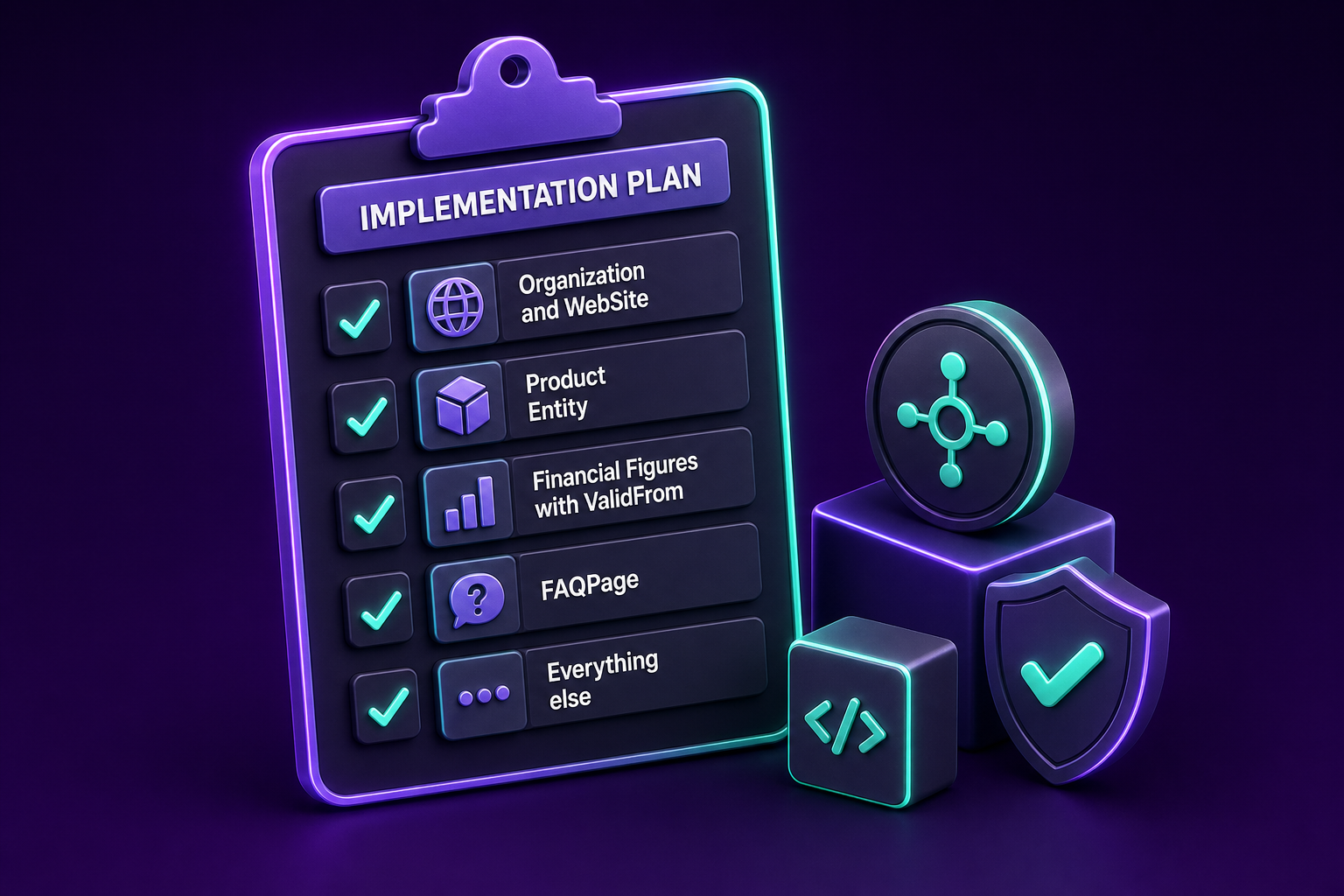
The Coinpresso Schema Markup Checklist
Audit first, and audit against the site as the crawler sees it rather than as your CMS shows it. Run every template through Google’s Rich Results Test and the schema.org validator, and for token pages, a crypto-specific checker such as the Crawlux Token Schema Tester, then list every entity the site declares and reconcile the list to one name, one URL, one identity.
Then deploy in this order, because each step is wasted without the one above it:
Then re-validate, re-crawl through Search Console, and watch the entity report for a week. The whole plan is doable in a fortnight for most sites — and it is the part of LLM optimization for crypto websites with the best ratio of effort to certainty, because it is one of the few where you can prove you did it right.
Here is the thing to check tonight, before you commission anything: open your homepage source, search for “@type”, and count how many different names your site gives itself. If the answer is more than one, that is where Coinpresso starts, and it is the first thing we fix in every Web3 GEO engagement we run.
FAQs
What schema types should a crypto exchange use?
FinancialService for the exchange entity, FinancialProduct for each listed asset or trading pair with provider pointing back to the parent, and Organization plus WebSite for the identity layer on the homepage. Fee schedules go in offers with a real price specification. Avoid custom types like CryptoExchange; validators accept them and engines ignore them.
Does schema markup directly improve AI search citations?
No, and anyone telling you otherwise is selling something. Google states that structured data is neither a ranking factor nor required for AI Overviews, and no controlled study has shown schema causing citations in ChatGPT, Claude or Perplexity for crypto queries specifically. What schema does is remove the ambiguity that stops an engine from understanding what your project is, which is a precondition for being cited rather than a cause of it.
How is DeFi protocol schema different from exchange schema?
An exchange is a financial service and can be marked as one. A DeFi protocol is not licensed and should not claim to be, so the working pattern is a split: SoftwareApplication for the dApp interface and FinancialProduct for the specific yield mechanics, linked with provider and isPartOf. This is Coinpresso’s synthesis against the base vocabulary, not a schema.org recommendation, because schema.org has no DeFi examples.
Should I use FAQ schema on every page of my crypto site?
No. Google removed FAQ rich results from Search in May 2026, so the visible snippet is gone, and a FAQPage block on every page reads as manufactured. Keep it on the two or three pages where buyers arrive with genuine questions and the answers are specific. Remove it everywhere else.
How do I validate my crypto site’s schema markup?
Run each template through Google’s Rich Results Test and the schema.org validator, and use a crypto-specific checker for token pages. Then do the check the validators cannot: list every entity your site declares and confirm they agree on one name, one URL and one identity. Contradictory entities are the most common fault in Web3 schema and no validator flags them.


