

Your project probably has better trust signals than the companies beating you in AI answers. It just publishes them where no machine will ever look.
That is the whole problem, and it is worth saying before the framework gets in the way. E-E-A-T, Google’s shorthand for Experience, Expertise, Authoritativeness and Trustworthiness, was built around named authors, licensed institutions and a paper trail. Your team may be pseudonymous. Your protocol may have no head office and no regulator to point at.
Read literally, the framework says you lose. Read properly, it says something more interesting: trust is the pillar that decides everything, and crypto can prove trust in ways a consultancy never could. On-chain, audited, timestamped, public. What most Web3 sites cannot do is present any of it in a form a language model will find, parse and repeat.
This piece takes each pillar in turn as it actually applies to a protocol rather than to a law firm, and ends with the audit checklist Coinpresso runs against client sites.
E-E-A-T is Dead, Long Live AI E-E-A-T
The framework has not died. It has had most of its internal organs replaced. The concept survives; the mechanism for proving it has been rebuilt for a machine reader instead of a human quality rater.
Google only settled the current shape in 2022, when it added Experience as a fourth pillar to what had been E-A-T. Experience means first-hand use of the thing, not research about it. That single addition matters more in crypto than almost anywhere else, because it is the one pillar a protocol can prove on-chain rather than through a biography.
The bigger shift is who is reading. BrightEdge has tracked AI agent requests reaching 88% of human organic search volume as of April 2026, and projects agents will overtake human search by the end of the year. Whatever your crypto SEO program has been optimizing for, half the audience asking about your project has stopped typing into a search box.
Here is the gap that should worry you. One analysis of AI Overview behavior found 96% of citations came from sources carrying strong E-E-A-T signals, which reads like a vindication of the old framework. Then read the companion finding: ranking first on Google correlates with an AI citation only about 22% of the time.
Put those together and the conclusion is uncomfortable. Engines are demanding E-E-A-T signals and refusing to read them off the page Google reads. Neither figure was measured on crypto sites, and no crypto-native version of that study exists yet, so treat it as the shape of the problem rather than a number to aim at.
Experience (E): Demonstrating Real Web3 Usage
For a crypto product, Experience means on-chain proof the thing is used. Not a whitepaper concept — actual use.
TVL, transaction counts and active wallets are your first-hand experience signal, and they have a property no Web2 testimonial can match: anyone can audit them, including a crawler. The catch is format — and it is where almost every protocol falls down.
An engine cannot read a TVL figure inside a Dune dashboard screenshot. It needs the number in text, in a table, with a date and a source, on a page it can crawl. This is the most common failure Coinpresso sees in protocol documentation: real traction, presented in a way no model will ever ingest.
If your usage data lives only in a Discord pin or behind an app login, it does not exist as far as an LLM is concerned. Structuring it properly is the foundation of any generative engine optimization for crypto and Web3 program, and it is a different craft from writing for people. You are writing data for machines that summarize it for humans afterward.
Expertise (E): The Pseudonymity Problem
A pseudonymous founder can prove competence. They just cannot do it with a headshot and a job title, which is exactly what the generic AI-search advice keeps recommending.
Expertise has to arrive as artifacts instead: commit history, published research, audit outcomes, how the protocol behaved the last time it was stressed. GitHub now does the job a résumé used to do.
Three years of substantive commits against a wallet address is a stronger signal to a model trained on code than a named CTO with “10 years in fintech” and nothing to check. Half of Web3 cannot or will not disclose identity, and most guides simply pretend otherwise.
Documentation carries weight too, but only when it reads like engineering rather than marketing. A model summarizing your mechanism design is drawing on the precision of your docs, not the confidence of your prose, which is where Web3 ghostwriting earns its keep when it is done by someone who understood the system before they wrote about it.
Authoritativeness (A): Beyond Backlinks
Backlinks are not dead. They were simply never the whole story, and in crypto they were never even most of it.
Developer adoption, ecosystem integrations and citations in technical work now carry authority that classic SEO never counted. A protocol listed as a dependency in other teams’ documentation, or cited in a paper on consensus design, is accumulating something no amount of guest posting replicates. That is authority earned through use rather than outreach.
Links still matter, though. Semrush’s audit framework groups AI trust signals into recognition, evidence and technical categories, and notes that engines lean on Google’s existing authority signals as a shortcut. So keep building them.
Judge them differently — that is all. Crypto link building in 2026 is worth doing when it produces the kind of mention a model would surface, and worth stopping when it only moves a domain rating.
Trustworthiness (T): The Ultimate AI Filter
Trust is the pillar that decides the rest, and Google says so outright: of the four aspects, trust is the most important, and content does not have to demonstrate all four to rank.
For crypto that is genuinely good news. A pseudonymous team with thin expertise signals can still win on trust, provided the trust signals are real and findable.
Security audits are the closest thing crypto has to a professional credential. CertiK alone has worked with more than 5,000 enterprise clients, secured over $600 billion in digital assets and flagged upwards of 180,000 vulnerabilities. That scale is the point: an audit is independently verifiable, third-party, and carries weight the auditor spent years building.
Bug bounties and published tokenomics finish the picture. A live bounty is an ongoing commitment rather than a one-time stamp, and vesting schedules with treasury addresses do for financial disclosure what an audit does for code. None of this is hard to publish. It is just rarely published in a form a model can read.
Structuring E-E-A-T Signals for LLMs
Every signal above is worthless locked inside a PDF a crawler skips. The highest-leverage fix most projects can make is moving audits, usage data and team documentation into structured, crawlable HTML.
Schema markup will not manufacture trust that is not there. What it does is tell a model what kind of claim it is looking at: an Organization, a SoftwareApplication, a review, a dataset. This is the mechanical half of LLM optimization for crypto websites, and most sites skip it because it changes nothing a human visitor can see.
An llms.txt file is worth adding alongside it, listing your canonical documentation, audit reports and key facts in plain text. It costs an afternoon and removes any ambiguity about which pages you consider authoritative.
The Role of Regulatory Clarity
Regulatory clarity is a trust multiplier by inference rather than by measurement, and that distinction deserves stating plainly. No study in this research showed a model citing a project because of its licensing status.
The logic still holds. If the trust pillar rewards transparency, then a MiCA registration or a clear statement of jurisdiction and compliance posture is about as unambiguous a transparency signal as a project can publish.
Expect it to compound with your other trust signals rather than work alone. Treat it as the most defensible inference here, not a proven lever, and do not rebuild a compliance strategy for AI visibility when the legal obligations should already be driving that decision.
E-E-A-T Audit Framework for DeFi
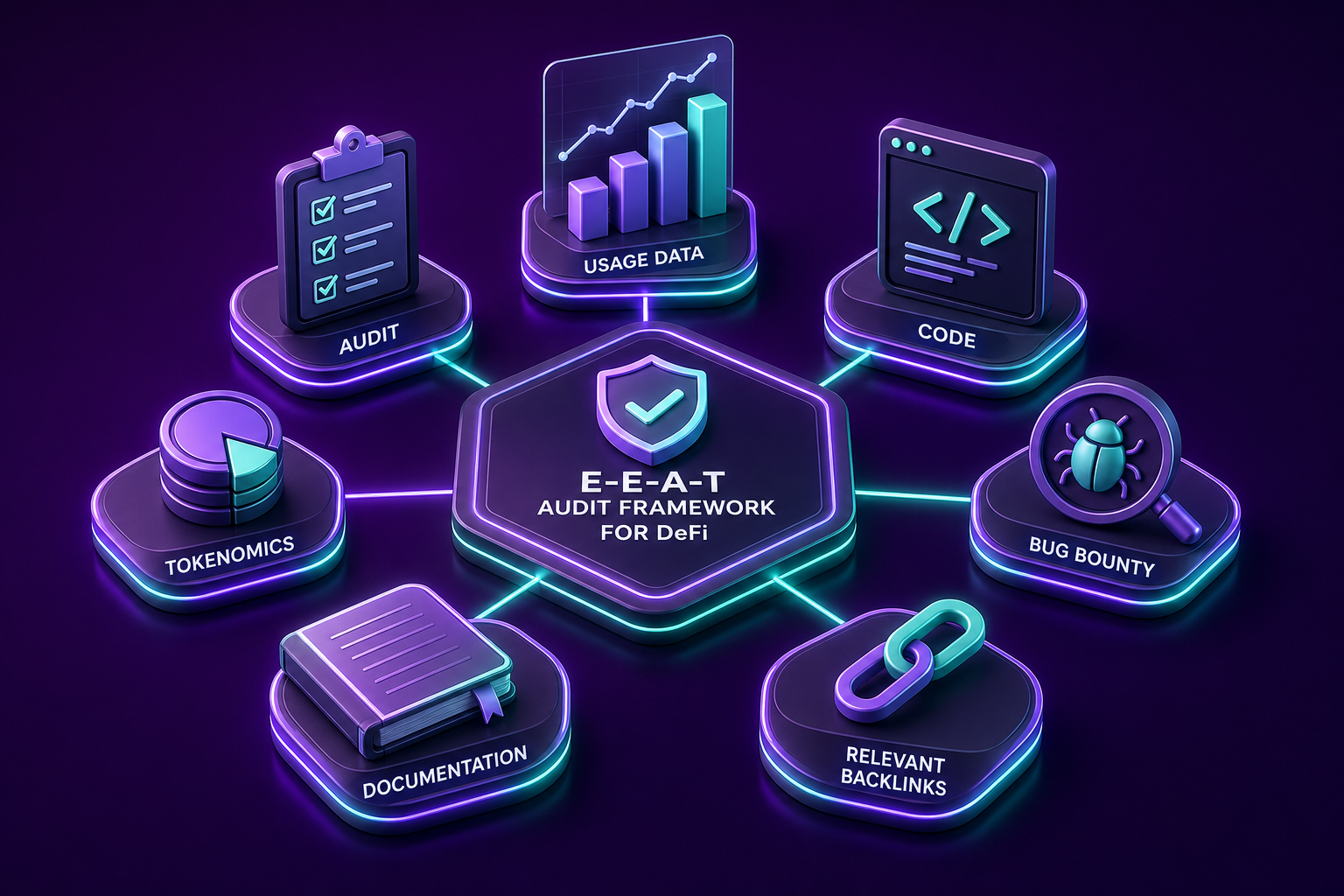
A protocol asking whether it is AI-visible should work through a short, specific list rather than commission a generic content audit. This is the “10,000 feet” version Coinpresso runs against client sites:
Most protocols pass two or three and assume the rest are optional. They are not, cumulatively, because engines appear to treat E-E-A-T closer to a gate than a scoring nudge. A protocol strong on audits but invisible on usage is still an incomplete picture to a model deciding whether to mention you at all.
Conclusion
E-E-A-T was never really about biographies and backlinks. It was always a proxy for whether something can be trusted, and crypto has better proxies for that than most industries will ever have. On-chain data beats a corporate disclosure. A published audit beats a claimed credential.
The problem has never been that crypto lacks trust signals — it is that almost nobody presents them where a model can read them.
We should be straight about the limits of our own evidence. Coinpresso does not yet have before-and-after data showing a client’s citation rate moving after an audit went into HTML or a tokenomics page went live, and we are not going to invent one. What we have is what we see running SEO, content and PR for live protocols: which signals move Google rank, and which get pulled into an AI answer. Those two lists overlap less than most founders assume.
So if ChatGPT still does not know your project exists, more content is unlikely to be the fix. Restructuring the trust signals you already have is a smaller job than a rebrand and a larger one than most teams expect. Start with the table above and be honest about which rows you fail.
FAQs
Does E-E-A-T apply differently to crypto sites than traditional finance sites?
Yes. Traditional finance proves E-E-A-T through regulatory licenses, named executives and mainstream coverage. Crypto has to prove the same underlying trust through on-chain transparency, published audits and visible developer activity, because the corporate credentials the framework assumes often do not exist in Web3 at all. Engines are still learning to weigh these Web3-native signals, which is why presenting them clearly matters more rather than less.
How can a pseudonymous crypto team demonstrate Expertise?
Through artifacts rather than identity: a verifiable commit history, published technical research, smart contract audit outcomes and real protocol performance data. The goal is machine-readable evidence of competence that never requires unmasking anyone.
Do security audits improve AI search visibility?
The evidence points that way, though no crypto-specific citation study exists yet to prove it. Audits from recognized firms are third-party verification a model can weigh, and analysis of the crypto wallet sector found security-firm citations matter more there than in almost any other crypto vertical. Publishing results as crawlable HTML rather than a linked PDF is the part most projects still get wrong.
How does on-chain data contribute to E-E-A-T?
It is your Experience signal: real TVL, genuine transaction volumes and actual active-user counts, independently verifiable rather than self-reported. It only helps visibility if published in a format a model can parse, which means tables and structured text on crawlable pages, not a dashboard screenshot.
Can a new crypto project build E-E-A-T quickly?
Not overnight, but the timeline compresses. Securing an audit before launch, publishing precise technical documentation, earning coverage in established crypto media and producing content with real depth in your niche all move faster than waiting years for authority to accumulate on its own.


