

Nearly half of everything Perplexity cites comes from review and comparison sites. Not a third, not a respectable slice — 47% of its citations across 1,648 sorted sources, a figure no other content format comes close to. If you have spent the last year producing thought leadership while your “best crypto exchanges” page sits untouched since 2024, that number should tell you where the money went.
It tells you something else as well. AI engines are not rewarding comparison pages because they are long or authoritative or well-linked. They reward them because the hard work is already done on the page. Options are weighed, data sits side by side, and there is a verdict a model can lift in one line and attribute in the next. Most crypto comparison pages fail that test because they were written to sell, and selling is the one thing an engine has learned to route around.
This is the full teardown of what a cited comparison page looks like, from the objective-arbiter positioning that earns the trust, through the table format and the summary, to the schema that makes it all machine-readable, so you can rebuild yours to be quoted rather than merely ranked.
Why AI Engines Love Comparisons
Start with what the engines themselves are telling you. Kevin Indig’s analysis of 30,000 AI citations across 500 software categories found that G2, whose entire format is structured comparison and review content, captured a 22.4% share of voice across ChatGPT, Perplexity and Google AI Overviews. One format, one site, more than a fifth of everything cited in its category. That is not a lucky page. It is a content type winning consistently because it was built to be lifted.
Crypto shows the same pattern with different names on it. 5W’s Crypto AI Visibility Index, which ran more than 65 consumer-intent prompts across five engines, found Coinbase and Kraken together taking roughly 22% of all crypto-category citations, and it logged “Coinbase vs Kraken” explicitly as one of the query patterns engines are answering. Two brands that are constantly compared against each other, taking nearly a quarter of a category between them — that is not a coincidence of brand strength. It is partly a function of how much comparison content exists about both. If you run any kind of crypto SEO programme, this is the format that has quietly become the most valuable page on the site.
The “Objective Arbiter” Positioning
Here is the part that most projects get backwards. The instinct is to write “Us vs Them”, a comparison where your product wins every row, and it is the fastest way to make sure an engine never cites you, because a model has no use for a page whose verdict it cannot trust.
Look at how the pages that do get cited handle it. Datawallet’s Coinbase vs Kraken comparison presents a split verdict rather than declaring one winner, with a disclosed methodology and a staff byline. CoinLedger’s version names a winner overall but concedes categories to the other side. Both read as an arbiter rather than an advocate, and that is the position you need to occupy even when one of the products is yours.
Compare fairly, lose the rows you should lose, and say so. The credibility you spend on that row is what makes the engine believe the rows you win.
The AI-Optimized Comparison Table
The table is the page. Everything else is context for it. And the table that gets cited follows rules that have nothing to do with how a designer would lay it out.
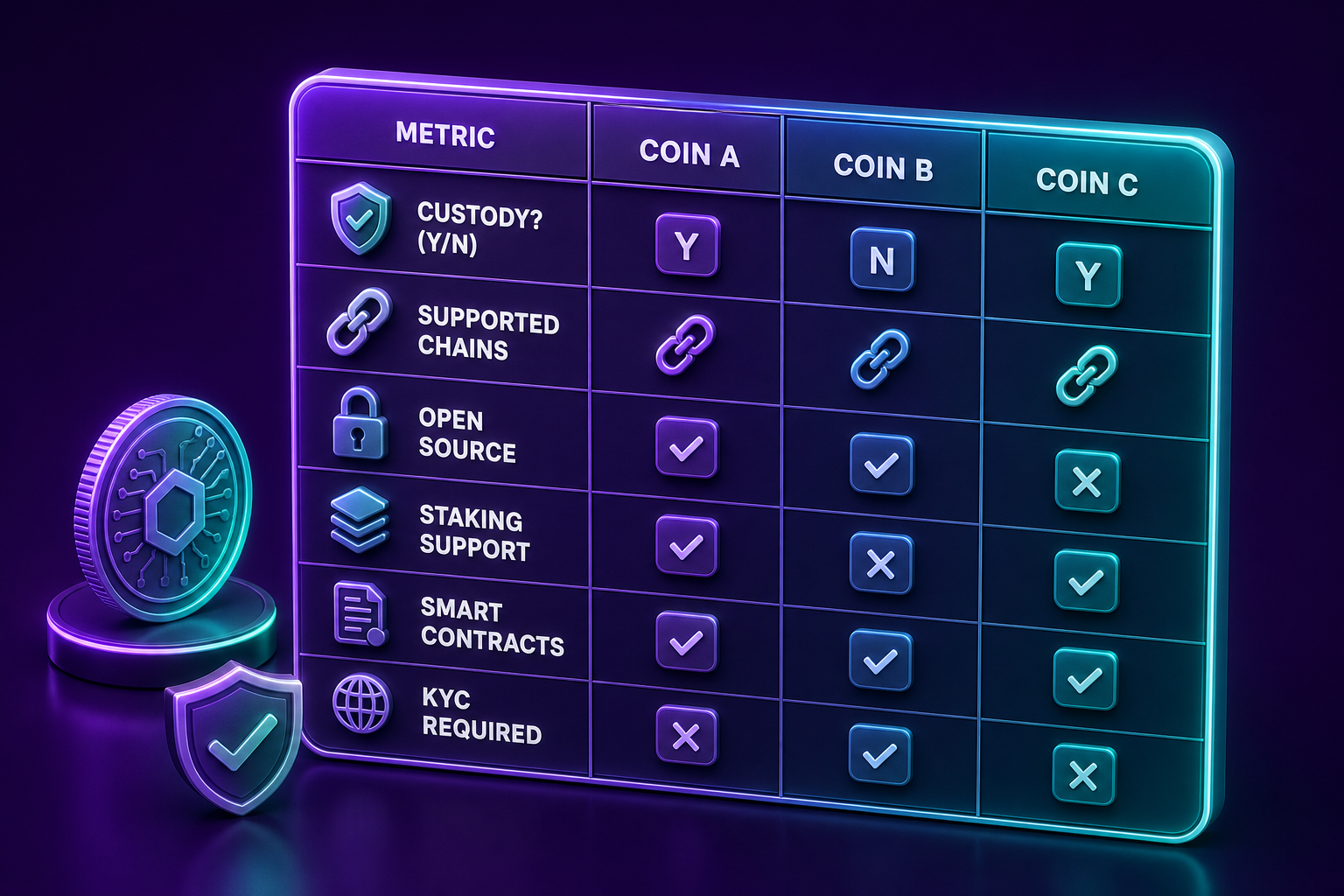
Clear headers, one metric per row, and binary or numeric cells wherever the truth allows: fees as a number, custody as “yes” or “no”, supported chains as a count and a list. Adjectives do not belong in a cell. “Competitive fees” is unparseable; “0.1% maker, 0.2% taker” can be lifted, compared and attributed, and it is the difference between a page a model can use and a page it has to interpret.
Give the engine a fact per cell and it has something to quote. Give it a slogan and it moves on — and it will move on to the competitor whose table it could read.
Structuring the Feature Breakdown
Beneath the table sits the breakdown, and its job is to be a hierarchy the machine can walk. One H2 per dimension of comparison, one H3 per product inside it, and the first sentence under each H3 stating the fact before any discussion of it. That ordering is not a style preference — the front-loading that decides whether a page is cited at all, covered below, holds inside every section too.
Keep each block self-contained. A model lifting the “Security” section should not need the “Fees” section to make sense of it, because it will not read both. Write every H3 as though it were the only paragraph on the page, and you will find the whole page gets cited more, one section at a time.
Handling Subjective Elements
Some things you genuinely cannot put in a cell. User experience, support quality, how it feels to use the thing. The temptation is to write your opinion, and your opinion is exactly what the engine will discard.
The move is to aggregate rather than assert. App store ratings with the count beside them. Trustpilot score and volume. Response-time figures where a platform publishes them. Community sentiment from a source you can link. Present the subjective dimension as a set of other people’s measurements with dates on them, and the engine has something it can cite without taking your word for it. Your own view can sit in one sentence afterwards, clearly labelled as yours, and it will be read as the editorial it is rather than mistaken for the data it is not.
The “TL;DR” Executive Summary
The top 100 words decide whether the page gets cited at all, and most comparison pages spend them on a preamble about how important choosing the right exchange is. Nobody has ever needed to be told that.
Open with the verdict. Name both products, say which is better for whom, and give the one number that most separates them, all in the first two or three sentences. Indig’s analysis of 1.2 million ChatGPT answers found 44.2% of citations drawn from the first 30% of an article, which is another way of saying the engine has usually decided before it reaches your third paragraph. That is the entire executive summary, and it should read like the answer a model would give if it had read the whole page, because that is precisely what a model is looking for: the answer, pre-written, so it can attribute it to you.
Schema Markup for Comparison Pages
The visible table tells a human the structure. Schema tells the machine, and for comparison content two types do the work. An ItemList wraps the compared products, with each itemListElement a Product or, for an exchange, a FinancialService carrying its own name, url and offers. That is the whole scaffold. What matters is that the schema and the table agree: the same products, the same fees, the same order. A page whose markup says one thing and whose table says another has told the engine it cannot be trusted on either.
We covered the wider mechanics of machine-readable structure in our crypto GEO guide, and the short version applies here unchanged: honest types, consistent identity, no invented vocabulary.
Updating Frequency and Freshness
A crypto comparison page decays faster than any other content you own. Fees change, chains get added, an exchange loses a licence, and a page that still says otherwise is not merely out of date. It is wrong, and an engine that has learned which sources go stale will drop it from the answer set without ceremony.
Set a review cadence and publish the date — a visible one, not a footer timestamp. Monthly for fee tables and supported-asset lists, quarterly for the rest, and a visible “last verified” line near the top that a model can read and a reader can trust. Indig’s data found that 58% of cited URLs appear in only one prompt, while the top 5% of pages answer ten or more. The pages in that top slice are the ones that stay current, because currency is what lets a single page keep answering as the questions change around it.
Conclusion
Strip away the detail and a cited comparison page is four decisions made well. Position as the arbiter, not the advocate, even when the product is yours. Put facts in cells and adjectives nowhere. Front-load the verdict and every section beneath it. Keep it current and say when you last checked. The rest is template, and a template is exactly what you should build: one structure, reused across every pairing your buyers actually search for, so that the third comparison page costs a tenth of the first.
We should be plain about one thing. Coinpresso does not yet have first-party before-and-after data on a crypto comparison page rebuilt to this standard, and we are not going to invent a case study to fill the gap. What we have is the structural evidence above and the format’s track record across every category it has been measured in. If you want yours rebuilt to it, contact Coinpresso for a free mini GEO audit of your existing comparison pages. It takes an hour, it costs nothing, and it will tell you which of the four decisions you are currently getting wrong.
FAQs
Why are comparison pages so effective for AI citations?
Because the extraction work is already done. A comparison page lays options side by side with attributable data and a verdict, which is exactly the shape an AI answer takes. Perplexity draws 47% of its citations from review and comparison sites, and G2’s comparison format captured a 22.4% share of voice across 500 software categories.
Should I compare my own crypto project against competitors?
Yes, if you can do it as an arbiter rather than an advocate. Lose the rows you should lose and say so. A page where your product wins every line is the one an engine will never cite, because its verdict cannot be trusted.
What format works best for crypto comparison tables?
Clear headers, one metric per row, and numeric or binary cells: fees as percentages, custody as yes or no, chains as a count. No adjectives in cells. Pages with concrete, populated attributes were cited 61.7% of the time against 41.6% for generic ones.
How many comparison pages should a crypto project have?
One for every pairing your buyers actually search for, built from a single template. The top 5% of cited pages answer ten or more distinct prompts, and a comparison page with a well-structured table naturally answers several. Start with the two or three pairings that appear in your own search data and expand from there.
How often should I update crypto comparison pages?
Fee tables and supported-asset lists monthly, everything else quarterly, and publish a visible “last verified” date. Crypto comparisons go stale faster than any other content type, and an engine that finds a wrong fee will drop the page rather than correct it.


