

Crypto content moves fast. One day it’s restaking, the next day it’s memecoins again, and somehow you still have to ship a weekly newsletter. Most posts burn bright and then disappear. That’s normal. But it’s also why so many teams feel stuck on a hamster wheel.
Here’s the part that should get your attention. In search results, older pages often win.
Ahrefs found that 72.9% of pages ranking in Google’s top 10 are more than three years old, and the average number one ranking page is five years old. In other words, content that keeps earning clicks over time has a real advantage.
So what if you built a content library that keeps working while the narrative changes? That’s the job of evergreen content. This guide explains what is evergreen content in plain language, then gives you a crypto-specific framework to plan it, write it, promote it, and keep it up to date. If you want help building this into a repeatable engine, start by mapping your core pages and workflows around crypto copywriting so your team can publish consistently without losing quality.
Defining Evergreen Content
Evergreen content is timeless, foundational content that stays relevant and valuable for a long time. It targets problems and questions your audience will keep having next month, next year, and probably five years from now.
A clean definition from HubSpot is that evergreen content covers topics that stay relevant and valuable over a longer period, with only minor updates needed over time. Semrush frames it similarly, describing evergreen content as content that remains relevant over a long period and requires few updates to continue providing value.
In crypto, evergreen content usually lives in the basics and the repeatable needs:
How wallets work and how to secure them
How smart contracts behave and what can go wrong
How DEX swaps, liquidity pools, and lending protocols work
How to read tokenomics, unlock schedules, and risk factors
How to avoid scams and verify information
These topics don’t go out of style. The interfaces change. The brands change. The core questions stay.
What Evergreen Content Looks Like in Practice
Evergreen content shows up as:
A definitive explainer that people bookmark
A tutorial that saves users from making expensive mistakes
A glossary that turns jargon into normal language
A checklist that helps someone decide quickly
A hub page that links to deeper resources
If you’re asking what is evergreen marketing, it’s the same idea applied to your whole content plan. You invest in assets that keep generating attention and trust over time, instead of constantly paying for new attention with new posts.
A Quick Comparison Table
Here’s a clear way to separate evergreen content from other types you probably publish.
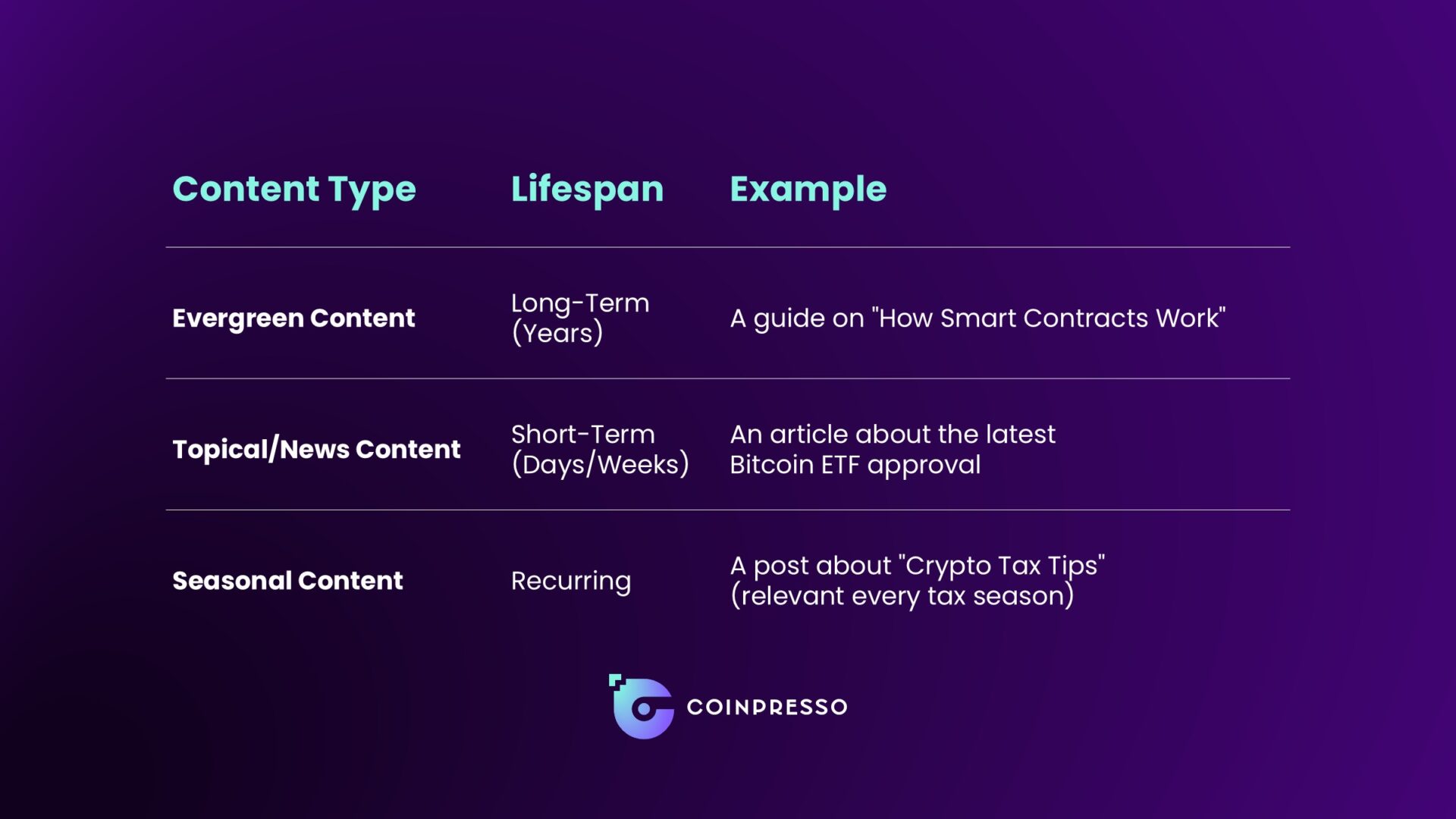
Notice what changes. News content depends on the moment. Seasonal content depends on the calendar. Evergreen depends on human curiosity and recurring problems.
Why Is It Called Evergreen?
Think about an evergreen tree. It keeps its leaves year-round. It doesn’t rely on one perfect week of sunshine to look alive. Evergreen content works the same way. It keeps attracting readers because the topic stays relevant, even when the market mood changes.
That doesn’t mean you publish it once and forget it forever. Crypto moves too much for that. But it does mean you can build a foundation that pays you back repeatedly, especially when you pair it with a strong SEO for crypto growth plan.
Why Evergreen Content is a Superpower for Crypto Projects
Evergreen content sounds calm. Crypto rarely is. That contrast is exactly why it works.
1. Builds Sustainable, Compounding Traffic
News posts spike and fade. Evergreen content grows more slowly, then keeps showing up. Over time, those steady clicks add up. And because older pages often dominate competitive SERPs, you’re building an asset that fits how search behaves in real life.
2. Establishes Authority And Trust When Trust Is Scarce
Crypto has a credibility problem that honest projects still pay for. When your site becomes the clearest explanation of a core topic, people treat you as a reference. That’s useful for users, journalists, partners, and even your own community mods who are tired of answering the same questions.
Authority also compounds. Strong, evergreen guides attract links, mentions, and citations over time, especially when supported by careful, crypto earned media agencies campaigns.
3. Higher Content Marketing ROI
Evergreen content takes more effort upfront. It’s harder to write. It requires better structure, stronger visuals, and clearer explanations. But once it ranks, it can outperform dozens of short-lived posts. This is the quiet math of content marketing ROI. One great evergreen article can keep generating traffic and leads long after a news post stops getting impressions.
If you want to turn that attention into sign-ups or product actions, you also need the page to convert. That’s where improving the on-page path matters, especially with conversion rate optimization strategies that match your audience’s intent.
4. Fuels Your Entire Funnel
Evergreen content gives you raw material for everything else. One solid guide becomes:
A week of short-form video scripts
A set of community FAQs
A sales enablement asset for partnerships
A sequence for onboarding emails
A set of visuals for social posts
So even if you mainly care about community growth, evergreen content still helps. It gives your team something useful to link in replies, DMs, and support tickets. That connects well with ongoing crypto social media marketing operations because you always have a helpful next step to share.
Evergreen Content Ideas and Examples for Crypto
This is the section your team will actually use. Below are evergreen content examples that work well in crypto because they match repeating questions and stable search intent.
Format 1: The Ultimate Guide
What it is:
A deep, comprehensive guide to a broad topic. It becomes your flagship resource.
Crypto example:
The ultimate guide to decentralized finance. Cover how DEXs work, what liquidity means, how lending rates form, and how users manage risk. Keep it beginner-friendly, but include enough depth to satisfy advanced readers.
Evergreen content ideas for this format:
Stablecoins explained with real-world use cases
Smart contract security basics
Tokenomics and vesting schedules
Bridging and cross-chain risk
Format 2: The “How-To” Tutorial
What it is:
A step-by-step post that helps someone do one task safely.
Crypto example:
How to set up and secure a MetaMask wallet. Include password practices, seed phrase storage, hardware wallet pairing, and common phishing traps.
Why it works:
The core steps stay similar. Screenshots and UI might change, but the user’s problem stays the same.
Format 3: The “What-Is” Explainer
What it is:
A foundational explanation of a core concept, written like you’re talking to a smart friend who missed the last two years of crypto.
Crypto example:
What are Layer 2 scaling solutions? Explain why they exist, how they reduce costs, what bridging means, and what risks users should understand.
This format also fits perfectly with what is evergreen content style posts, because the goal is clarity, not hype.
Format 4: Case Studies
What it is:
A story with a measurable outcome. It can be your own project, a partner, or a user journey, as long as you have proof.
Crypto example:
How did your protocol help a partner reduce settlement time, lower operational cost, or improve onboarding completion? Avoid vague wins. Show the steps and the result.
Case studies can be evergreen when the lesson stays relevant, even if the exact numbers age. The trick is to focus on the process and decision-making, not just the outcome.
Format 5: Original Research And Data Reports
What it is:
A report based on unique data that other people cite. This becomes a link magnet and supports evergreen content SEO.
Crypto example:
The state of NFT royalties in 2026. Track marketplace changes, creator earnings trends, and how enforcement or policy shifts affect revenue.
To get more lift, publish the full report plus smaller assets. Make a chart pack. Make a summary post. Turn one chart into one short video. And if you want those citations to turn into backlinks, align research with a clear outreach plan through crypto press release distribution.
The Evergreen Content Creation Framework
This is the part where the evergreen content strategy becomes real. You can run this as a monthly process with a small team, or as a quarterly sprint with a bigger one.
Step 1 – Keyword Research For Timeless Topics
Your goal is consistent demand, not a temporary spike.
How to find evergreen topics:
Start with beginner questions that your community asks repeatedly
Look for terms that relate to fundamentals and workflows
Check if search demand stays steady across months
Avoid topics that depend on one event, one product launch, or one meme narrative
Build a list of 30 to 50 topics. Then pick the best ones based on business relevance and ranking difficulty.
If the keyword supports a product action, a key feature, or a conversion step, prioritize it. If it only attracts curiosity with no next step, keep it lower in your list.
Step 2 – Analyze the SERPs Like a Competitor, Not a Fan
Before you write, open the top results and ask:
What format wins here, guide, list, glossary, or tool
What questions do they answer early
What do they skip or explain poorly
What proof do they include, screenshots, examples, data
How old are the pages and how often do they update
Remember the Ahrefs finding that most top 10 pages are older than three years. (That doesn’t mean you can’t rank. It means you need to publish something better and keep it current.
If you want to turn your evergreen library into a real authority cluster, you’ll eventually need smart internal linking and supporting pages. That’s where planning a structure alongside link acquisition starts to matter.
Step 3 – Create And Optimize With Clarity And Depth
This is where most crypto content falls apart. Teams try to sound smart. Readers want to understand.
A simple structure that works:
Start with the plain definition
Explain why it matters
Walk through the mechanics
Show an example
Share common mistakes
Add a short FAQ
End with the next step
On-page SEO basics still matter:
Use one clear H1 and logical H2s
Keep paragraphs short
Add descriptive subheadings
Use visuals where they reduce confusion
Link to supportive pages on your own site
Add a table or checklist when it saves time
Also, make the page fast and readable. If your site struggles with speed or layout, evergreen content won’t reach its full potential because users bounce. That’s a technical and UX issue, so it’s worth treating your content pages as product pages, often with help from crypto web developers.

FAQ Section
How is evergreen content different from a pillar page?
They overlap. A pillar page is a specific format for a broad evergreen topic. It acts as a hub that links to supporting articles. Many pillar pages are evergreen. A simple how-to post can be evergreen without being a pillar.
Can a topic like best crypto wallets be evergreen?
Yes, but it needs regular updates. The core intent stays stable. The wallet landscape changes. Treat it as evergreen with an annual refresh.
How much of my content strategy should be evergreen?
A practical rule is 80-20. Put most effort into evergreen content, then use a smaller share for news or narrative posts that capture short-term interest.
My project is technical. Can I create evergreen content?
Yes. Technical explainers are some of the best evergreen assets. A clear guide to how your protocol works can attract developers and advanced users for years.
How do I measure the success of my evergreen content?
Look at long-term trends. Track sustained organic traffic over 6 to 12 months, backlinks earned over time, rankings for core terms, and conversions, such as sign-ups, demos, or community joins.


