

Launching a Web3 project is a different ball game compared to a standard Web2 startup or company launch. Many founders have moved from Web2 into Web3, assuming their skill sets transfer perfectly, that the market and community behave the same, often leading to mistakes and sometimes even the early failure of a project.
For this reason, developing a crypto go-to-market strategy with the support of experts from the crypto marketing industry often determines whether a new project succeeds or fails. This article will provide a comprehensive crypto go-to-market strategy for founders and help traders identify projects with long-term growth based on their approach, while avoiding those run by teams unfamiliar with the Web3 space.
Web3 vs. Web2 GTM: Key Differences
To operate effectively in the Web3 industry, founders and content managers have to understand that there is a clear shift in stakeholders. In Web2, the primary stakeholder is the customer. In Web3, stakeholders include users, developers, investors, and partners, and all of these groups can be incentivized through tokens linked to the project.
A clear example of this difference can be seen in a DeFi protocol. In Web2, a fintech app simply attracts users to deposit funds. In Web3, a DeFi protocol not only attracts users but also rewards them with tokens for providing liquidity, participating in governance, or promoting the platform. This creates a system where multiple stakeholders are aligned and actively contribute to growth.
The role of tokens is critical in solving the cold start problem. By offering early incentives such as token rewards, projects can bootstrap initial activity and liquidity before the product reaches large-scale adoption. This helps create early traction that would be difficult to achieve through traditional methods alone.
Community is also far more important in Web3 than in Web2. Strong communities drive awareness, trust, and ongoing engagement. Social media platforms like X, Discord, and Telegram play a key role in building and maintaining these communities through direct and constant interaction.
The Web3 GTM Matrix: Where Does Your Project Fit?
Before defining a go-to-market strategy, a project needs to understand its position. Not all Web3 projects operate the same way. Some rely heavily on tokens and decentralization, while others focus more on product and user growth. This matrix helps teams identify their model and choose the right strategy.
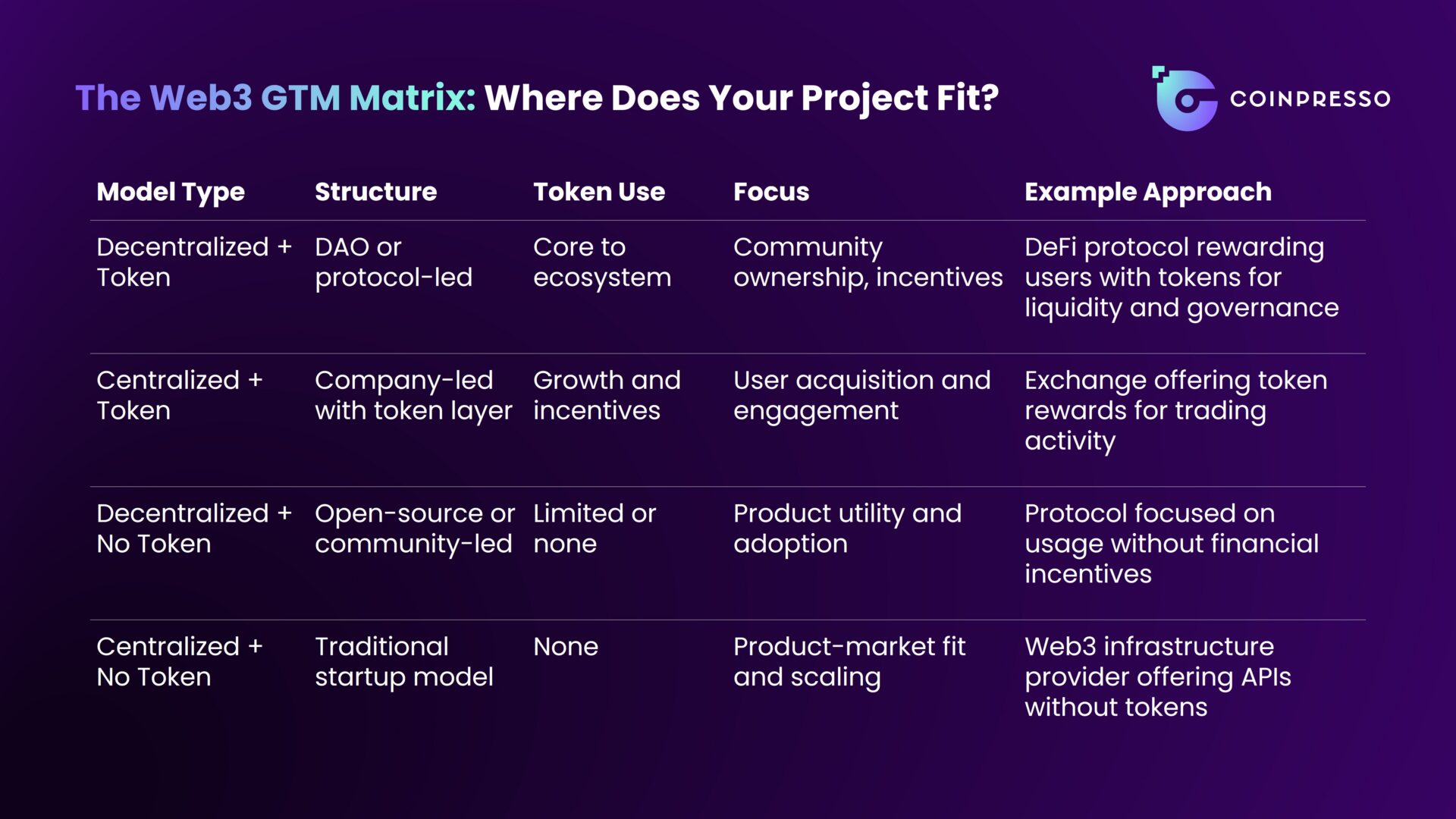
Choosing the right position in this matrix shapes everything from messaging to content strategy. A token-driven project needs strong education and trust-building content, while a product-led project may focus more on use cases and performance.
The Three Pillars of a Crypto Launch Strategy
There are three critical pillars to a crypto go-to-market strategy that all projects must have ready as they build toward and execute their product launch. The correct structuring of the launch strategy ensures that stakeholders are able to analyze and understand the incentives they have for holding tokens and helps encourage community-driven growth in both the short and long term.
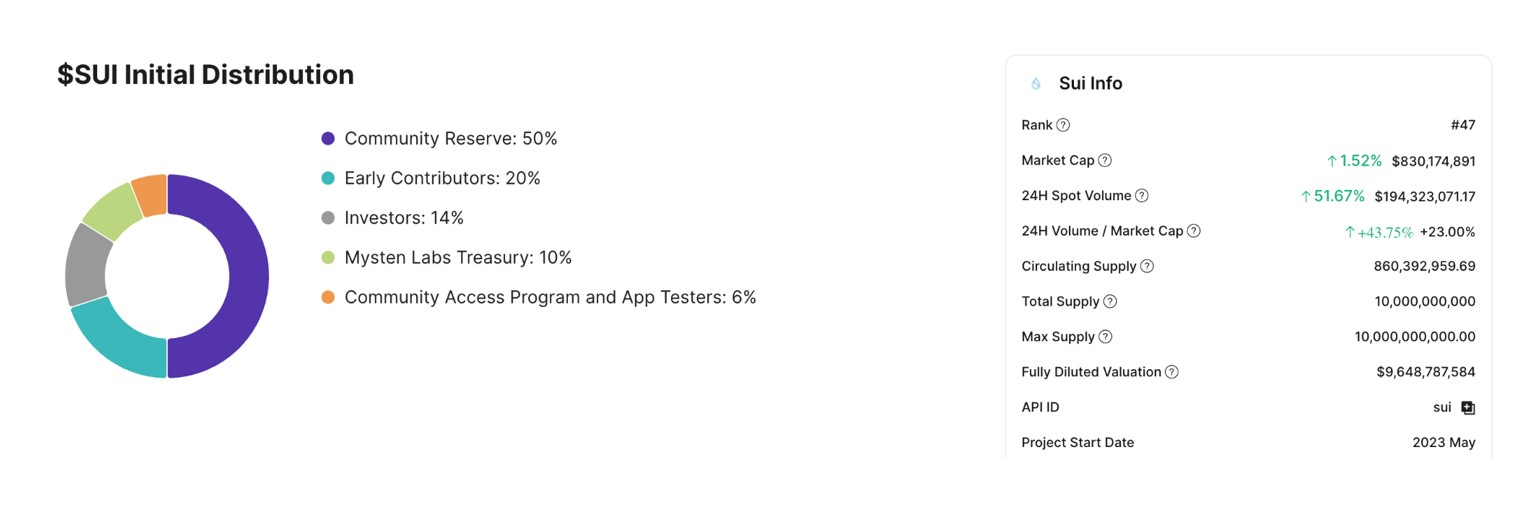
Tokenomics is critical for attracting stakeholders, especially traders and VC investors. Tokenomics refers to the supply, distribution, and utility of a token within a project. A strong example is Sui, which has a maximum supply capped at 10 billion tokens. This is publicly verifiable, and the project launched with a clear distribution model, helping investors understand how tokens would enter circulation.
Fair distribution is essential for long-term value. Projects must clearly communicate allocation and vesting schedules to avoid sudden sell-offs that can damage price stability. Well-structured vesting builds confidence and reduces the risk of early investors exiting too quickly and impacting the market.
Pillar 2: Community Building & Governance
Another key aspect of any Web3 launch is the community. Unlike Web2, where community often plays a limited role, in crypto, it is central to success. The most successful projects build and maintain large, active communities that they can incentivize through tokens, creating ongoing engagement and growth.
Projects must also turn users into active participants. Platforms like Discord and Telegram are used to engage users, gather feedback, and build loyalty through direct interaction.
Governance tokens are another important factor. Projects operating with DAO structures rely heavily on their communities. For example, on Aave, token holders can vote on key decisions, giving users a real role in shaping the protocol.
Pillar 3: Product-Led Growth in Web3
Finally, the product must solve a real problem, either on-chain or off-chain. The market is now too crowded for projects that do not clearly fill a niche. Strong UX and accessibility are essential to reduce barriers to entry. This is why platforms like Uniswap and PancakeSwap have become dominant in the DEX market.
Choosing Your Launch Sequence
Although the launch timeline can differ from project to project, there is a rough outline that most teams follow. In addition, for teams with limited experience in this area, often working with a crypto marketing agency or group of external advisors can help navigate the process.
Step 1: Define the product and market fitBefore anything goes live, the team needs to be clear on what the DEX actually offers. For a BNB-focused DEX, this could mean lower trading fees, faster swaps, or better support for BNB Chain tokens.
Step 2: Build the brand and core messagingThe project then needs clear messaging that explains why users should care. This includes the website copy, social media presence, pitch deck, and launch content.
Step 3: Grow the early communityBefore launch, the team should begin building an audience on Discord, Telegram, and X. This gives the project an initial user base and allows feedback before the platform is fully live.
Step 4: Launch the product or testnet firstFor most projects, it is safer to let users interact with the DEX before pushing the token too hard. This helps prove that the product works and gives the team real usage data.
Step 5: Introduce token incentivesOnce users are active, the project can launch token rewards, liquidity incentives, or governance features. In a BNB-focused DEX, this could include rewards for providing liquidity to major BNB trading pairs.
Step 6: Expand through partnerships and campaignsAfter launch, the team should focus on integrations, influencer support, paid campaigns, and ecosystem partnerships to keep growth moving.
Executing the GTM Tactics
There’s a considerable range of GTM tactics that can be executed during the launch process. Most of these are not available in the Web2 market, and they enable rapid growth in adoption by expanding the stakeholder base.
Airdrops and Retroactive RewardsDistribute tokens to early users to reward activity and attract attention. For example, rewarding users who tested a DEX before launch.
Liquidity MiningIncentivize users to provide liquidity by offering token rewards. A BNB-based DEX might reward users for adding liquidity to BNB trading pairs.
Referral and Ambassador ProgramsEncourage users to bring in new participants through rewards or tiered incentives.
Developer Grants and HackathonsAttract builders to expand the ecosystem, especially important for protocols and infrastructure projects.
Strategic Partnerships Integrate with other Web3 platforms to access their user base and improve utility.
Influencer and Community CampaignsUse trusted voices in the space to promote the project and build credibility quickly.
Although not all projects can leverage all of these options, every project will be able to access at least a few of them, even if they have a limited budget.
Final Thoughts on the Best Crypto Go-To-Market Strategy
For Web2 natives, shifting into the Web3 space is not as easy as many assume. Even if their products overlap, the market is vastly different. Understanding the wide range of stakeholders and how to incentivize them through an effective go-to-market strategy is critical to success, as it lays the groundwork for long-term growth and stability, both in terms of token performance and user adoption.
FAQs
What is the biggest mistake projects make in their Web3 GTM strategy?
The most common mistake is relying too heavily on token incentives like unsustainable yield farming. This may drive short-term growth, but without real product value, users leave once rewards drop.
Do I need a token to launch a successful Web3 project?
No. A token is not required. Many successful Web3 companies, such as OpenSea, operate without one. A token should only be introduced if it has a clear purpose, such as governance, utility, or aligning incentives across stakeholders. Otherwise, it can create unnecessary complexity and risk.
How do I measure the success of a crypto launch?
Look beyond basic metrics:
Total Value Locked (TVL)
Active users and retention
Developer activity
Token distribution and holder growth
These give a clearer picture of real adoption.
What is the role of PR in a Web3 go-to-market strategy?
PR builds credibility. Coverage in trusted crypto and financial media helps validate the project and attract both users and investors.
How early should I start planning my crypto GTM strategy?
As early as possible. GTM planning should run alongside product development, since community building, partnerships, and token design all take time to execute properly.


