Once you’ve picked a platform from our best crypto casinos for gamers guide, the next step is actually funding your account. This walks through the full deposit process, including how to bring in gaming tokens specifically, the mistakes that cost people money, and how to keep the process secure.
Before you deposit: get your wallet ready
You’ll need a self-custody wallet — MetaMask, a hardware wallet, or a chain-specific wallet depending on what you’re depositing (the Ronin Wallet for Axie/Pixels tokens, for example). If your crypto currently sits on an exchange, you have two options: deposit directly from the exchange if the casino supports it, or withdraw to your own wallet first for an extra layer of control. Casinos generally accept deposits from either source, but withdrawing to your own wallet first gives you a clean record of what’s yours versus what’s still custodied by an exchange.
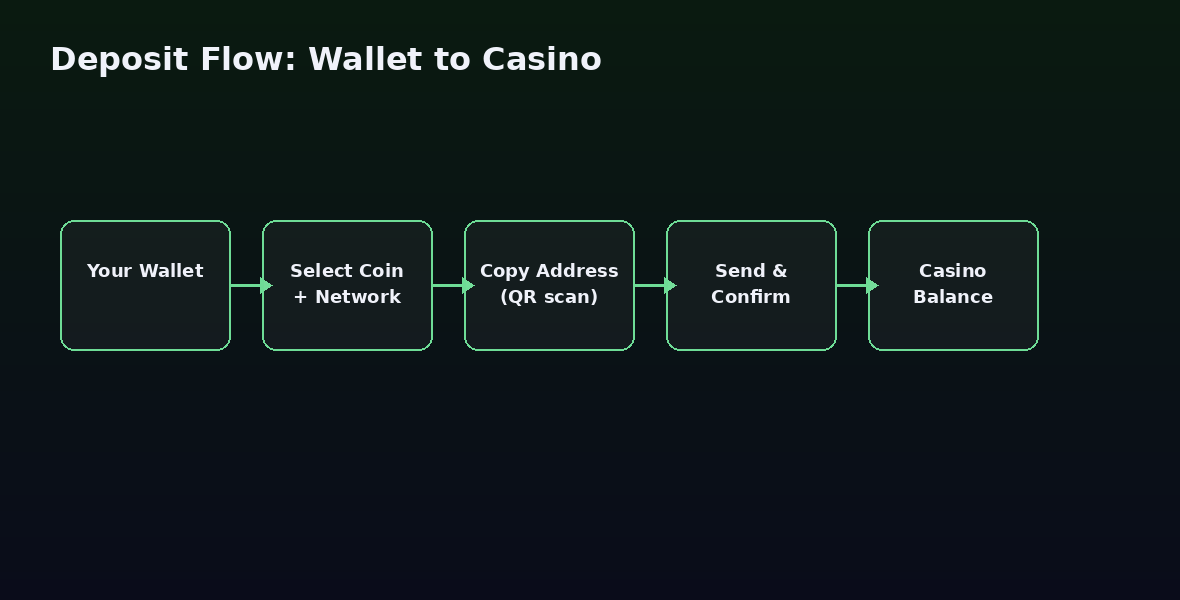
Step-by-step deposit process
- Create and log into your casino account. Most crypto casinos need only an email and password to get started — see our Cloudbet review for what account creation looks like at a specific platform.
- Navigate to the deposit or wallet section. This is usually a dedicated tab, separate from the games themselves.
- Select your cryptocurrency. Choose the specific coin you’re depositing — BTC, ETH, USDT, or one of the growing list of altcoins and gaming tokens supported by major platforms.
- Confirm you’re on the correct network. This is the single most important step and the one most likely to cause an irreversible mistake — see the warning below.
- Copy the generated deposit address. Never type it manually; always copy-paste or scan the QR code to avoid transcription errors.
- Send the transaction from your wallet. Double-check the address and amount before confirming — blockchain transactions cannot be reversed once broadcast.
- Wait for network confirmations. Most major coins confirm within minutes; some networks are faster than others (see the comparison below).
The single biggest mistake: wrong network
Many coins exist on multiple blockchain networks — USDT, for example, can run on Ethereum, Tron, Solana, and others, each with a different address format. Sending funds to a correct-looking address on the wrong network is one of the most common ways people permanently lose crypto, because the receiving platform’s wallet on that specific network doesn’t exist to catch it. Before every deposit, confirm that the network selected in your wallet matches the network the casino’s deposit address was generated for. If you’re ever unsure, send a small test amount first — the extra few minutes cost nothing next to the risk of an irreversible loss.
Depositing gaming tokens specifically
If you’re bringing tokens earned from a play-to-earn game or held as a gaming crypto coin investment rather than BTC or ETH, check the casino’s live deposit list before assuming it’s supported. Coverage varies significantly — some platforms accept dozens of altcoins and gaming tokens directly, while others stick to major coins and stablecoins only.
If your specific token isn’t supported, you’ll need to swap it for a supported coin (typically USDT or ETH) on an exchange first — see our guide to the best crypto exchanges for gaming tokens — then deposit the swapped amount. Factor in both the exchange’s swap fee and the network fee for the subsequent transfer — for smaller amounts, these combined costs can eat a meaningful percentage of what you’re depositing, so it’s worth checking total costs before committing to the swap.
Understanding confirmation times and network fees
Confirmation speed and cost vary substantially by network:
- Bitcoin: Typically 10-60 minutes depending on network congestion and the fee you pay; higher fees get prioritized faster.
- Ethereum: A few minutes typically, though gas fees can spike significantly during high network demand.
- Solana: Usually confirms in seconds to a couple of minutes, with very low fees.
- XRP / Tron: Generally fast (under five minutes) with minimal fees, which is why they’re popular for smaller, frequent transactions.
If speed matters more to you than which specific coin you hold, choosing a faster network for casual play (rather than defaulting to Bitcoin out of habit) can meaningfully improve the experience.
Common deposit mistakes to avoid
- Sending on the wrong network — covered above, and the costliest mistake by far.
- Typing an address manually instead of copy-pasting or scanning a QR code, risking a single-character error that sends funds to an unrelated wallet.
- Ignoring minimum deposit amounts — some casinos set a minimum below which deposits aren’t credited or are difficult to recover.
- Depositing directly from an exchange that doesn’t support external wallet withdrawals to the casino’s specific network, resulting in a stuck transaction.
- Not accounting for network fees when sending an exact balance, leaving nothing to cover the transaction cost and causing it to fail.
After you deposit: security basics
Once funds are in your casino balance, treat the account with the same care as any financial account: enable two-factor authentication if offered, never share login credentials, and avoid leaving large balances sitting on the platform longer than needed — withdraw winnings back to your own wallet regularly rather than treating the casino balance as long-term storage. For the full picture on evaluating whether a specific platform is worth trusting with your deposit, see our guide to crypto casino safety.
Minimum deposits and small-amount considerations
If you’re depositing a small amount to test a platform before committing more, pay close attention to both the casino’s stated minimum deposit and the network fee you’ll pay to send it. On a network with higher fees (Bitcoin or Ethereum during congestion), a $10 test deposit could lose a meaningful percentage to fees alone, while the same amount sent over Solana or Tron arrives almost fully intact. If you’re specifically testing the waters, choosing a low-fee network for that first small deposit is a simple way to make the test itself more representative.
What to do if a deposit doesn’t show up
First, check the transaction on a public block explorer for the network you used, searching by your wallet address or the transaction hash. If the transaction confirmed on-chain but hasn’t appeared in your casino balance, the usual next step is confirming you sent to the correct address for the correct network and then contacting the casino’s support with the transaction hash — this is the single piece of information that lets support actually trace what happened, so have it ready before you reach out. Genuine confirmed deposits on the correct network almost always resolve; funds sent to a mismatched network are the scenario least likely to be recoverable, which circles back to why getting the network right the first time matters more than any other step in this guide.
Frequently Asked Questions
What happens if I send crypto to the wrong network?
In most cases, the funds are unrecoverable. Some exchanges and wallets offer manual recovery for specific network mismatches, but it’s not guaranteed and often involves fees or lengthy support processes — prevention through careful network selection is far more reliable.
Do I need to complete KYC before depositing?
Usually not for the deposit itself — most casinos let you deposit and play with minimal verification. KYC typically becomes required at withdrawal, especially above certain thresholds.
Can I deposit directly from an exchange like Coinbase or Binance?
Generally yes, as long as the exchange allows withdrawals to external addresses on the correct network. Some exchanges restrict withdrawals to gambling-related addresses depending on regional regulations.
Is it safer to deposit from an exchange or a self-custody wallet?
Both work, but a self-custody wallet gives you full control over the transaction and avoids any exchange-side restrictions or delays. It’s generally the more flexible option if you deposit regularly.
Ready to deposit?
Compare platforms and their specific supported coins in our best crypto casinos for gamers ranking before you send your first transaction.