
Crypto casinos come with their own vocabulary, part gambling terminology, part crypto jargon. This glossary breaks down the terms you’ll run into across our best crypto casinos for gamers guide and reviews, so you can read any bonus page or game rules without guessing.
Odds, math, and game mechanics
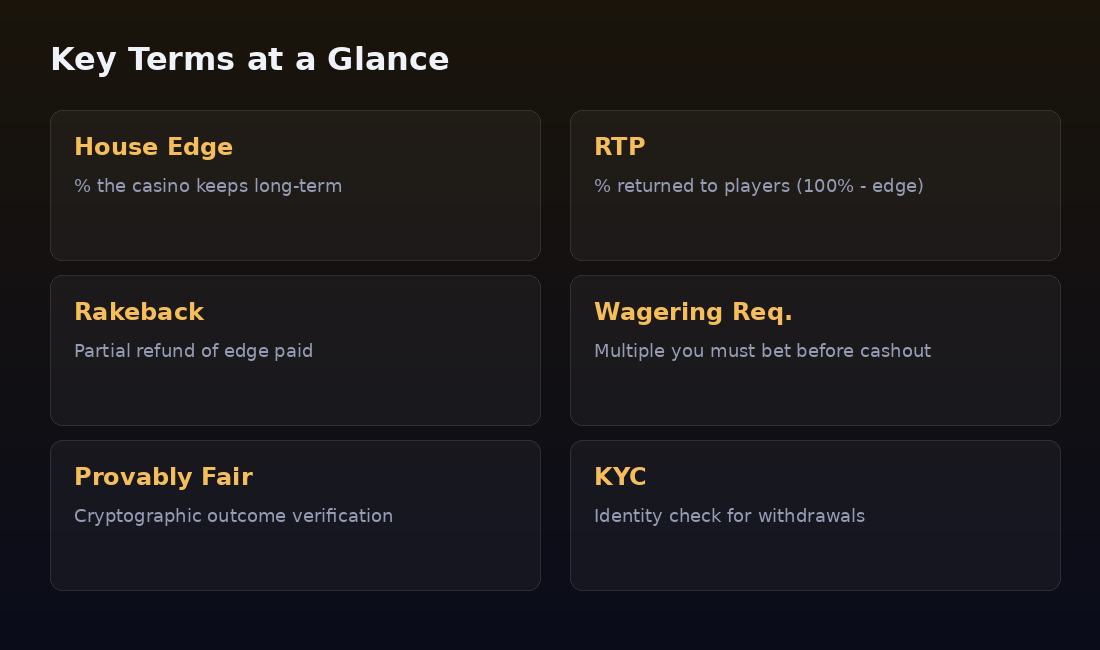
House edge
The mathematical advantage a casino holds over players, expressed as a percentage. A 2% house edge means the casino keeps 2% of all money wagered over the long run, on average, across the entire player pool — not necessarily from any single session. See our full breakdown in the crypto casinos guide.
RTP (Return to Player)
The mirror image of house edge: 100% minus house edge equals RTP. A slot with 96% RTP returns, on average, $96 for every $100 wagered across millions of spins. RTP is set by the game studio, not the casino itself.
Provably fair
A cryptographic system letting players independently verify that a game’s outcome wasn’t altered after they placed their bet. Read our full explainer on provably fair mechanics for how the verification actually works.
Variance (or volatility)
How much a game’s results swing around its average return. High-variance games pay out rarely but big; low-variance games pay smaller amounts more consistently. Both can have the same RTP while feeling completely different to play.
Originals
Games built in-house by a casino specifically — dice, crash, plinko, mines, and similar titles — as opposed to licensed slots sourced from third-party studios.
Bonuses and rewards
Wagering requirement (playthrough)
The multiple of a bonus amount you must bet before you can withdraw any winnings derived from it. A $100 bonus with a 30x wagering requirement means you need to wager $3,000 in total before those funds (or winnings from them) become withdrawable.
Rakeback
A partial refund of the house edge you’ve paid across your wagers, typically calculated as a percentage and paid out on a schedule (daily, weekly). It functions as a loyalty reward rather than a one-time bonus.
Deposit match bonus
A bonus where the casino matches a percentage of your deposit with bonus funds, usually up to a cap (for example, a 100% match up to $500 doubles a $500 deposit into $1,000 total).
VIP tier / VIP program
A loyalty structure that rewards cumulative wagering volume with escalating perks — better rakeback percentages, dedicated support, exclusive promotions — the more you play over time.
Staking rewards
Rewards earned by locking up a platform’s native token (like BetFury’s BFG) rather than spending it, generating passive returns independent of individual bet outcomes.
Cashback
Similar to rakeback but usually calculated on net losses over a period rather than total wagered volume — you get back a percentage of what you lost, not what you bet.
Crypto and wallets
Self-custody wallet
A wallet where you control the private keys directly (MetaMask, a hardware wallet), as opposed to leaving funds on an exchange or casino balance where a third party technically holds them.
Hot wallet vs. cold wallet
A hot wallet stays connected to the internet for convenience (useful for active play); a cold wallet stores keys offline for long-term security. Best practice: keep only what you’re actively playing with in a hot wallet.
KYC (Know Your Customer)
Standard identity verification required by licensed operators, typically triggered at certain withdrawal thresholds. See our Cloudbet review for a real example of how KYC tiers affect withdrawal limits.
Network fee (gas fee)
The fee paid to the underlying blockchain to process a deposit or withdrawal, separate from anything the casino itself charges. Fees vary significantly by chain — Bitcoin and Ethereum fees can be higher than networks like Solana or Tron.
Licensing and safety
Curaçao OGL (Online Gaming Licence)
Curaçao’s newer licensing framework, which replaced the older master/sub-license model with stricter compliance and reporting requirements. Worth checking which framework a casino operates under — see our full crypto casino safety guide for how licensing tiers compare.
Self-exclusion
An account-level tool letting a player lock themselves out of a platform for a set period, or permanently, as a responsible gambling safeguard.
Deposit limit
A cap you set on how much you can add to your casino balance over a given period (daily, weekly, monthly), enforced by the platform rather than relying on your own willpower mid-session.
Games and betting terms
Crash game
A betting format where a multiplier climbs continuously from 1x, and players must cash out before it randomly “crashes” back to zero. Rollbit and BetFury both run popular crash titles as part of their originals lineup.
Dice game
A provably fair casino original where players bet on whether a generated number will land above or below a chosen threshold, with payout odds adjusting based on the probability selected.
Live dealer
Games (blackjack, roulette, baccarat) streamed with a real human dealer in real time, as opposed to purely digital RNG-based versions. Provably fair verification in the cryptographic sense doesn’t apply here the same way it does to originals, since a physical dealer and cards are involved.
Faucet
A feature (or third-party site) that distributes small, free amounts of crypto periodically, sometimes used by casinos as a low-stakes way to try games without depositing.
Account and platform terms
Reality check
A periodic on-screen summary of session time and net result, designed to counter how extended play sessions distort a player’s sense of how much they’ve actually won or lost.
Loss limit
An account setting that caps the maximum amount you can lose over a chosen period, distinct from a deposit limit, which caps how much you can add to your balance in the first place.
Frequently Asked Questions
What’s the difference between house edge and RTP?
They’re mathematical opposites: RTP is what a game returns to players on average, house edge is what the casino keeps. RTP + house edge always equals 100%.
Is rakeback the same as a welcome bonus?
No — a welcome bonus is a one-time offer for new players, usually tied to your first deposits. Rakeback is an ongoing reward tied to how much you continue to wager over time.
Why do withdrawal limits depend on KYC?
Licensed operators are required to verify player identity above certain thresholds as part of anti-money-laundering compliance, which is why unverified accounts typically face lower daily withdrawal caps.
Keep this glossary handy
Bookmark this page and refer back to it whenever a bonus page or game rules screen uses a term you don’t recognize. For the full comparison of platforms using these mechanics, see our best crypto casinos for gamers ranking.