If you’ve spent any time reading our best crypto casinos for gamers guide, you’ve seen “provably fair” mentioned as a trust signal. This guide explains exactly what that means, how the math actually works, and how to verify a bet yourself instead of just taking a casino’s word for it.
What “provably fair” actually means
Provably fair is a cryptographic system that lets a player verify, independently, that a game’s outcome wasn’t altered after they placed their bet. It doesn’t mean a game has better odds or a lower house edge — it means the casino cannot secretly change the result once you’ve committed to a wager. That’s a meaningfully different guarantee than “trust us, our RNG is certified,” which is how traditional online casinos typically operate.
The system works by combining three pieces of data: a server seed (generated by the casino, kept hidden until after the round), a client seed (which you can set yourself), and a nonce (a number that increments with each bet). These three inputs run through a hashing algorithm to produce the game’s outcome — and because hash functions are deterministic, the same three inputs will always produce the same result.
How the verification actually works
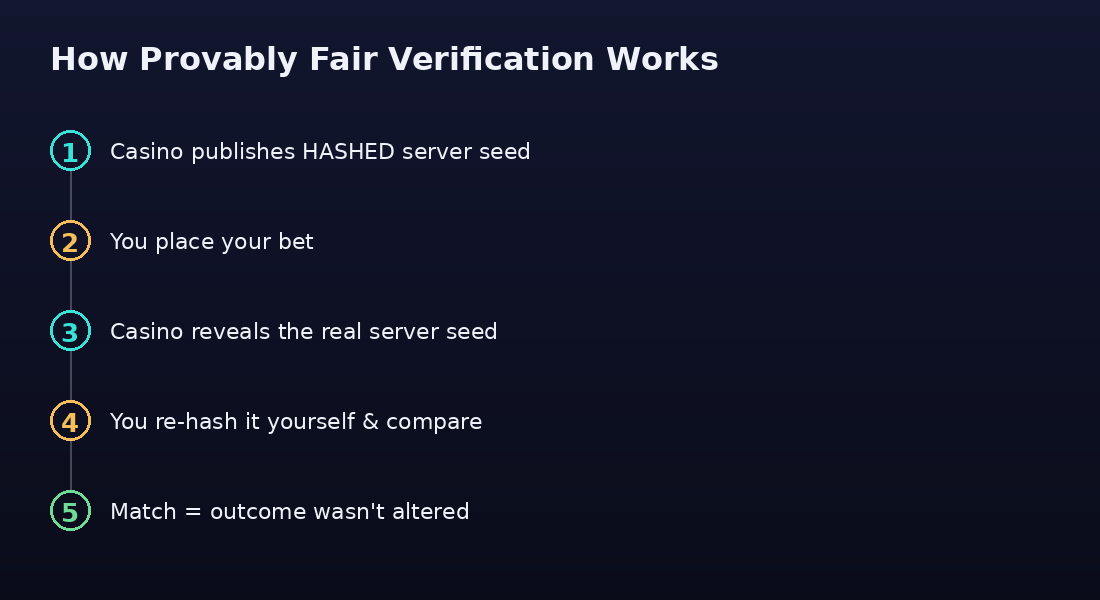
Before you place a bet, the casino shows you a hashed version of its server seed — a scrambled string that’s mathematically impossible to reverse-engineer back into the original seed. This is the key step: the casino is committing to a specific server seed before it knows your bet, without revealing what that seed actually is.
After the round resolves, the casino reveals the original (unhashed) server seed. You can then run that seed, your client seed, and the nonce through the same hash function yourself — using a third-party verification tool, not the casino’s own site — and confirm it produces the exact hash you were shown beforehand. If it matches, the casino couldn’t have changed the outcome after your bet, because doing so would have produced a different hash than the one it already committed to.
Most provably fair casinos, including the platforms in our crypto casino ranking, provide a built-in verification tool on their site, and independent third-party verifiers exist as well for anyone who wants to double-check without relying on the casino’s own tooling.
What provably fair does NOT guarantee
This is the part most casual explainers skip, and it matters: provably fair verifies that a specific outcome wasn’t tampered with after the fact. It says nothing about:
- House edge. A provably fair game can still have a high house edge — fairness and generosity are two different things entirely.
- Long-term results. Verifying one bet tells you that bet wasn’t rigged; it tells you nothing about whether you’ll win or lose over a thousand bets, which is governed by the published house edge regardless.
- The casino’s solvency or licensing. A casino can run mathematically fair games and still be an unlicensed operator that delays withdrawals or disappears with player funds. Provably fair is about game integrity, not business trustworthiness — see our full guide to crypto casino safety for the platform-risk side of the equation.
Provably fair originals vs. licensed slots
There’s an important distinction between two categories of games at any crypto casino:
Originals — dice, crash, plinko, mines, and similar games built in-house by the casino — are where provably fair verification applies most directly and transparently. These games typically publish an exact, checkable house edge (often 1%-3%) precisely because their mechanics are simple enough to verify with the seed system described above.
Licensed slots from third-party studios (NetEnt, Play’n GO, Pragmatic Play, and others) use RNG certified by independent testing labs rather than the seed-and-hash system. This is a different — not worse — form of fairness verification, but it isn’t something you personally verify per-spin the way you can with an original. If a casino advertises “provably fair slots,” check specifically whether that applies to studio-made titles or only to in-house originals, since the terminology gets used loosely across the industry.
Why this matters specifically for gamers
If you’re coming from competitive gaming, this concept should feel familiar: it’s the same instinct that makes players scrutinize drop rates, matchmaking algorithms, and hit registration in traditional games. Provably fair exists because crypto casinos operate in a space with historically less regulatory oversight than licensed traditional gambling, and cryptographic verification fills part of that trust gap directly — you don’t have to take the operator’s word for it, you can check the math yourself.
A worked example
Say a casino shows you a hashed server seed of a1b2c3... before you play. You set your client seed to something memorable, and the nonce starts at 1 for your first bet. You place a dice roll. The casino combines the (still-hidden) real server seed, your client seed, and nonce 1 through its hash function to generate the roll result — say, 47.2. You win or lose based on where that number falls relative to your target.
After the round, the casino reveals the actual server seed it used. You take that seed, your client seed, and nonce 1, run them through the same publicly documented hash function using an independent verifier, and check two things: first, that hashing the revealed server seed produces the exact hashed string you were shown before you bet; second, that combining the three inputs produces the same 47.2 result you were given. If both check out, the casino couldn’t have altered the outcome after the fact — any change to the server seed would have produced a different hash than the one it already committed to publicly.
This is why the order of operations matters so much: the hash commitment happens before your bet, and the reveal happens after. That sequencing is the entire mechanism that prevents after-the-fact manipulation.
Changing your client seed
Most platforms let you change your client seed at any time, and some players rotate it periodically as an extra layer of confidence — since you control this input, you can be certain the casino didn’t tailor a server seed specifically around a client seed it could predict in advance. In practice, the hash commitment already prevents this kind of manipulation, but changing your client seed occasionally costs nothing and can’t hurt.
Frequently Asked Questions
Is provably fair the same as a licensed casino?
No. Provably fair verifies individual game outcomes; licensing verifies the operator meets regulatory standards for solvency, dispute resolution, and responsible gambling. A casino should ideally offer both — see our breakdown of licensing in the crypto casino safety guide.
Can I verify a bet after the casino changes its server seed?
Yes — reputable platforms let you view and verify your full bet history, including past rounds using previous server seeds, not just your most recent session.
Does provably fair apply to slots?
Only loosely. Licensed slots use studio-certified RNG rather than the seed-and-hash system. “Provably fair” in the strict cryptographic sense applies most directly to casino originals like dice, crash, and plinko.
Do I need technical knowledge to verify a bet?
No — most casinos and third-party tools provide a simple interface where you paste in the seed values and nonce, and the tool runs the verification for you.
Putting it into practice
Next time you play at a provably fair casino, try verifying a single bet using the casino’s own tool before moving on. It takes under a minute and turns an abstract trust claim into something you’ve personally confirmed. For a ranked comparison of casinos that implement this properly, see our best crypto casinos for gamers guide, including our full Cloudbet review.