Before you deposit at any platform in our best crypto casinos for gamers ranking, it’s worth understanding exactly what “safe” means in this context — because it actually covers two separate questions that get conflated constantly.
Two different kinds of risk
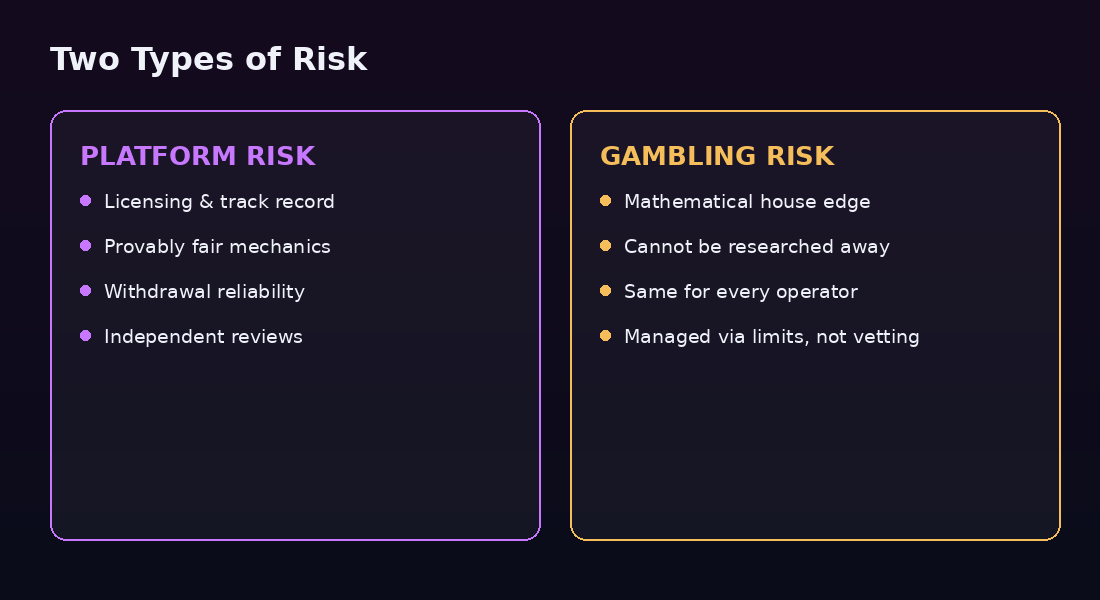
Platform risk asks: is this specific operator trustworthy? Will it pay out my winnings, protect my funds, and operate within the rules it advertises? This is the risk that varies enormously between operators, and the one you can actually research and mitigate.
Gambling risk asks: what’s the mathematical chance I lose money betting? This risk is inherent to gambling itself and doesn’t change no matter how trustworthy or well-licensed the platform is — a perfectly safe, perfectly licensed casino still has a house edge, and you can still lose your deposit playing entirely as intended.
Conflating these two is how people end up either overly paranoid about a legitimate platform, or dangerously overconfident about their odds at a genuinely safe one. Treat them as separate questions with separate answers.
Evaluating platform risk: what to check
Licensing
Look for a specific, verifiable license rather than a vague “licensed and regulated” claim. Curaçao’s newer OGL (Online Gaming Licence) framework, which our Cloudbet review covers in detail, requires stricter compliance than the older master/sub-license model many crypto casinos still operate under. Other jurisdictions (Malta, the UK Gambling Commission, Kahnawake) apply their own standards — generally, the more established the regulator, the more oversight exists, though this often trades off against crypto-friendliness, since some of the strictest regulators don’t license crypto-native operators at all.
Operating history
A platform that’s operated continuously for several years without major scandal has survived market cycles, regulatory scrutiny, and the operational pressure of actually paying out winnings at scale. New platforms aren’t automatically untrustworthy, but they carry more unknown risk simply by lacking a track record.
Provably fair implementation
Genuine cryptographic verification, not just a marketing badge — see our full explainer on how provably fair actually works and how to verify a bet yourself rather than trusting a logo.
Independent player reviews
Search for player experiences on independent forums and review aggregators, specifically around withdrawal times and dispute resolution — not just the testimonials featured on the casino’s own site, which are inherently selective.
Transparent terms
Clear, findable information on wagering requirements, withdrawal limits, KYC thresholds, and restricted jurisdictions. Vague or buried terms are a warning sign regardless of how polished the rest of the site looks.
Red flags to watch for
- No verifiable license displayed, or a license number that doesn’t check out against the regulator’s public registry.
- “No verification ever” promises — legitimate operators require KYC at some threshold as part of standard anti-money-laundering compliance; a platform avoiding this entirely is avoiding regulatory obligations, not offering a convenience.
- Withdrawal delays with no clear explanation, especially if support becomes unresponsive once a withdrawal is requested.
- Bonus terms that are difficult to find or change after you’ve already opted in.
- No provably fair verification tool despite claiming to offer provably fair games.
- Aggressive, unsolicited promotional contact after a single visit, suggesting your data may be shared beyond the platform itself.
Managing gambling risk: what actually helps
Since gambling risk can’t be eliminated through platform vetting, the tools that matter here are behavioral and account-level, not research-based:
- Set a deposit limit in your account settings before you play — this is the single most effective control, because it removes the decision from the moment-to-moment pressure of an active session.
- Treat any winnings as a bonus, not an expectation. House edge means the mathematical expectation over time favors the casino, regardless of short-term variance in either direction.
- Use self-exclusion tools if you notice play becoming compulsive rather than entertaining — every licensed operator we cover supports this.
- Never chase losses by increasing bet sizes to recover a deficit — this is one of the most well-documented patterns that turns entertainment into a genuine problem.
A quick pre-deposit checklist
- Does the platform display a specific, checkable license?
- Has it operated for multiple years without major unresolved complaints?
- Does it offer genuine, verifiable provably fair mechanics?
- Are withdrawal limits and KYC requirements clearly stated?
- Have you set a personal deposit limit before making your first deposit?
If you can answer yes to the first four and you’ve completed the fifth yourself, you’ve covered both sides of the safety question about as well as research allows.
How licensing bodies actually compare
Not all licenses carry equal weight, and understanding the differences helps you read a casino’s footer claims more critically:
- Curaçao OGL: The newer, stricter Curaçao framework, requiring dedicated compliance and reporting. Still generally lighter-touch than traditional gambling regulators, but a meaningful step up from the legacy Curaçao sub-license model many older crypto casinos still hold.
- Malta Gaming Authority (MGA): One of the more rigorous licensing bodies in online gambling generally, though relatively few crypto-native casinos hold an MGA license due to stricter compliance costs and requirements.
- UK Gambling Commission: Among the strictest regulators globally, but does not license crypto-native casinos in practice — UK-facing operators generally operate through traditional payment rails instead.
- Kahnawake Gaming Commission: A Canadian Indigenous-territory regulator used by a range of online gambling operators, with a moderate compliance bar between Curaçao and MGA/UKGC.
The practical takeaway: a Curaçao OGL license is a reasonable baseline for a crypto casino, but it’s not equivalent to MGA or UKGC-level oversight. Weigh licensing alongside operating history and provably fair implementation rather than treating any single license as a complete safety guarantee on its own.
Why crypto casinos rarely hold the strictest licenses
It’s worth understanding why crypto-native casinos cluster around Curaçao rather than stricter regulators: most top-tier gambling authorities (UKGC, several US state regulators) either explicitly prohibit cryptocurrency as a payment method or require banking relationships that crypto-first operators can’t easily establish. This isn’t necessarily a red flag specific to any one casino — it’s closer to a structural reality of the current regulatory landscape — but it does mean the licensing bar for the entire crypto casino category sits lower than for traditional online gambling, which is exactly why the other checks in this guide (operating history, provably fair, independent reviews) carry extra weight when evaluating a specific platform.
Frequently Asked Questions
Are crypto casinos regulated?
Some are, some aren’t — regulation varies enormously by operator and jurisdiction. Check for a specific, verifiable license rather than assuming all crypto casinos operate under the same standards.
Is my crypto safe on a casino platform?
Funds held on any platform, including a casino, carry custodial risk — the platform technically controls the wallet, not you. Minimize this by withdrawing winnings promptly rather than leaving large balances parked on the site.
What’s the safest type of crypto casino game?
“Safest” in terms of fairness verification points toward provably fair originals with published house edges. In terms of gambling risk, no game is inherently safer financially — lower house edge games simply lose your bankroll more slowly on average.
Can I get my money back if a crypto casino scams me?
It depends heavily on licensing and jurisdiction. A licensed operator under a real regulator gives you a dispute-resolution path; an unlicensed offshore platform generally does not, which is exactly why licensing matters more than bonus size when choosing where to play.
Where to start
All four platforms in our best crypto casinos for gamers ranking meet the licensing and track-record bar described above — start there, then apply the deposit-limit habit from day one regardless of which one you choose.